


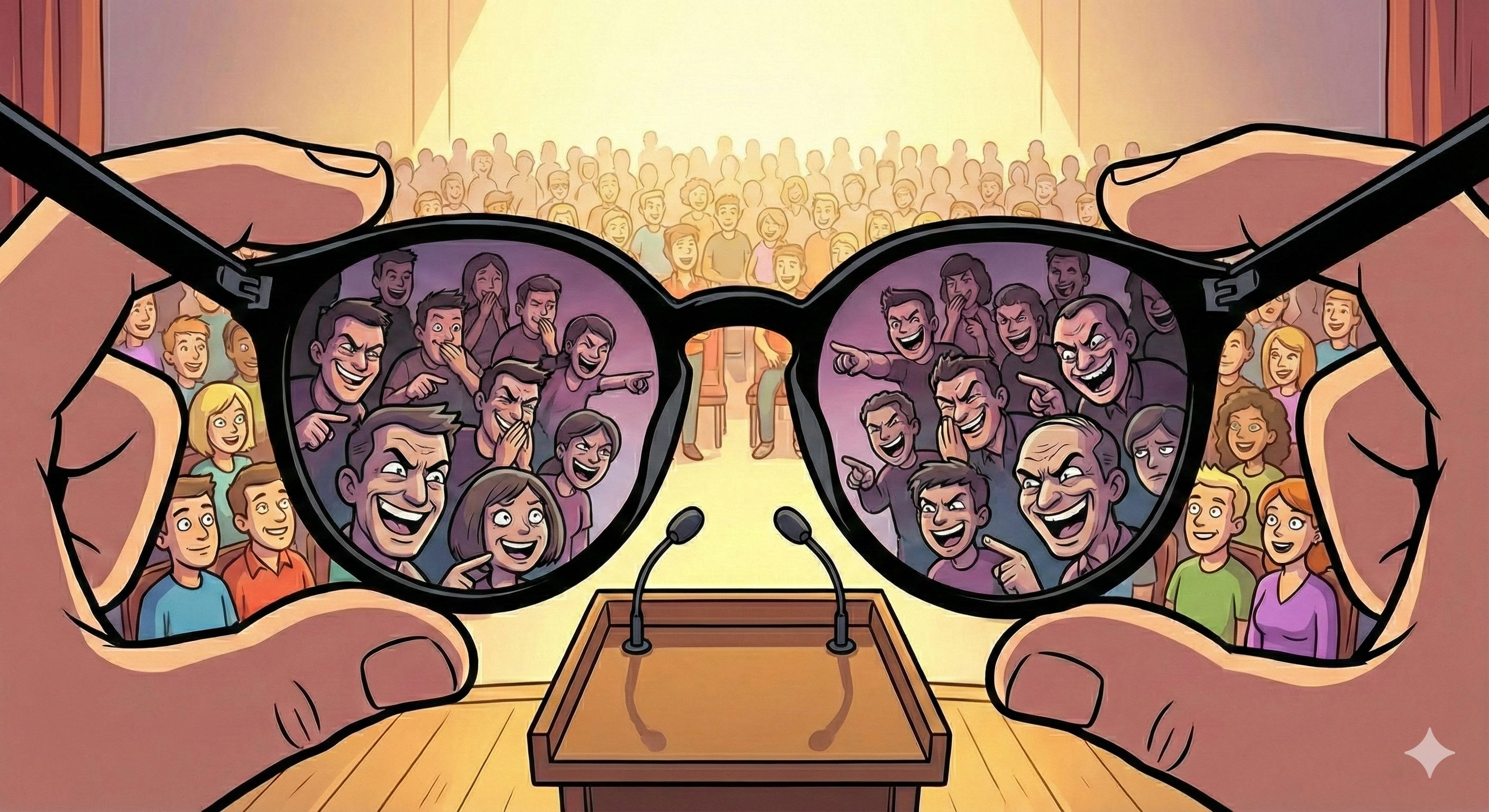
You’re about to give a presentation. Your brain offers a thought: “You’re going to embarrass yourself.”
You didn’t ask for it. You don’t want it. But now it’s there, and suddenly your chest tightens, your palms sweat, and you’re scanning the room for exits.
If you’re like most people, you think the problem is that you had the thought.
But everyone’s brain produces thoughts like this. The problem isn’t having thoughts. The problem is that you believed it - that you treated a random sentence in your head as if it were a fact about the world.
You Don't Experience Thoughts as Thoughts - You Experience Them as Reality
Imagine you've worn blue-tinted glasses your whole life. You wouldn't think, "Everything looks blue because of my glasses"- you'd just think the world is blue.
This is how thoughts work. Your brain produces thousands of them a day - automatically, unbidden - and each one colours the way your world looks.
So when your brain produces “you’re going to embarrass yourself,” you don’t notice a thought arriving. You notice a fact about the presentation. When it produces “I’m awkward,” you don’t experience a sentence - you experience a world in which you are, in fact, awkward.
Psychologists call this cognitive fusion - being so merged with a thought that you can’t see it as a thought. And it’s the default state for most of us.
Most People Try to Analyse the Thought While Still Believing It
The natural response to fusion is to try to think your way out. When "I'm going to embarrass myself" shows up, the instinct is to argue with it. Am I really going to embarrass myself? What's the evidence? Maybe I won't. But what if I do?
This is like trying to inspect your glasses while they're still on your face. You can't see them clearly because you're still seeing through them. The tint is everywhere - in the room, in your judgment, in the conclusions you're reaching about whether the tint is real.
The alternative is to take the glasses off first - then decide what to do. Not to argue with the thought, but to step back and see it for what it is: a sentence your brain produced. Not a fact. Not a prediction. Just words.
Two Ways to Take the Glasses Off
Every technique below does the same thing: it creates space between you and the thought.
The first is to change how you relate to the thought - treating it as an event happening inside your skull rather than a fact about the world.
The second is to weaken the thought’s emotional charge. Thoughts feel true partly because they feel heavy. Reduce the weight, and they’re easier to set down.