


If you have ADHD, you might have spent your entire life feeling like the volume dial on your emotions is turned way, way up. You aren’t alone in this: up to 70% of people with ADHD struggle with emotional dysregulation.
For years, you might have been labeled as the “sensitive kid,” the “bad kid,” or felt like you had to manually learn how to regulate your feelings. Today, we are diving into the neuroscience of ADHD and why emotions can feel so overwhelming, along with practical strategies to help you manage them.
Why ADHD makes emotions harder to handle
In the ADHD brain, the regions that generate emotion respond more strongly, and the ones that would normally regulate them respond less strongly.
The mismatch sits between two systems:
The prefrontal cortex (behind the forehead) handles pausing, planning, and choosing a response. In ADHD it’s less active, especially under stress.
The amygdala generates rapid emotional reactions. In ADHD it tends to be more reactive.
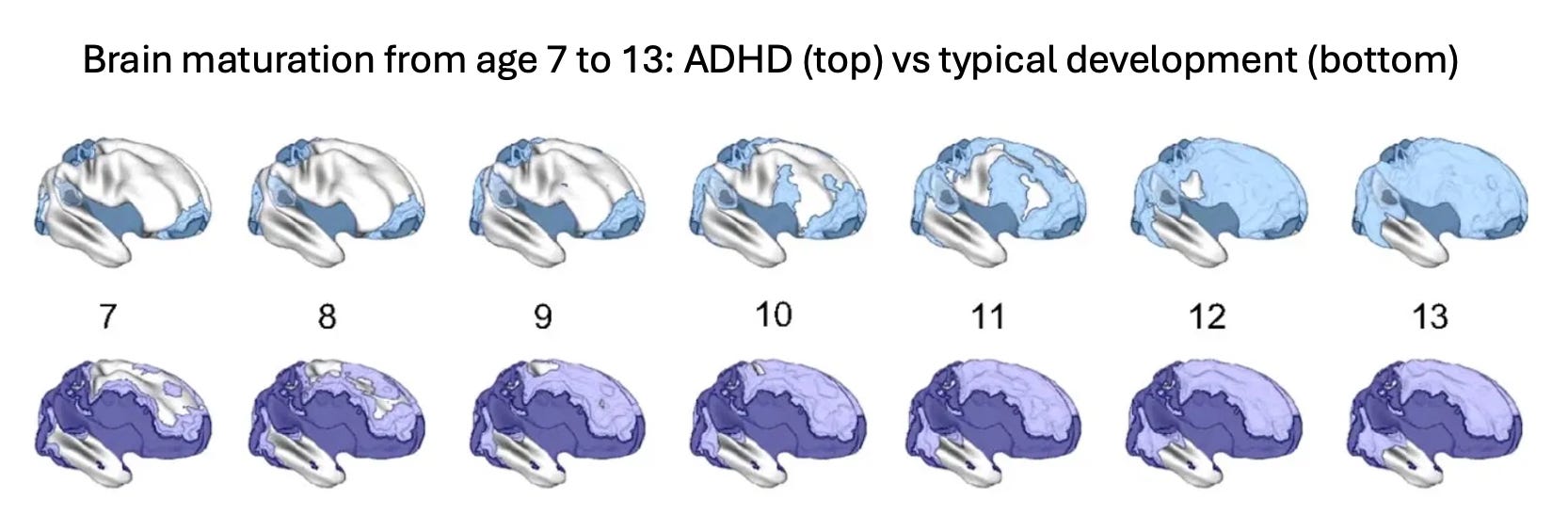
Part of why is timing. Brain scans show the prefrontal cortex reaches full thickness about three years later in ADHD children, and reduced prefrontal function persists into adulthood for around two-thirds of them.
All of this shows up in daily life as executive dysfunction - difficulty with the skills your brain uses to manage thoughts, actions, and emotions in pursuit of a goal. When those skills are impaired, emotion regulation breaks down in a handful of predictable ways - five of which probably feel familiar:
Five ways executive dysfunction affects emotion
Reduced impulse control. The reaction comes out before the brain has had a chance to filter it. You've snapped, sent the message, or stormed out of the room before you've consciously decided to.
Difficulty shifting emotional states. Once a feeling settles in, it tends to stick. Hyperfocus can lead you to ruminate on the same small comment for hours, or carry a bad mood from one part of the day into the next.
Lower frustration tolerance. Small setbacks feel disproportionately big. A delayed train, a confusing form, or someone interrupting you can feel briefly unbearable.
Time blindness. When something feels bad, it feels like it's always felt this way and always will. The knowledge that you'll probably feel fine again in an hour isn't really available in the moment.
Reduced working memory. Processing a feeling involves holding several pieces of information in mind at once. When working memory is limited, you can lose track of the fact that the situation is temporary, or forget the calming approach that's worked before.
That's a lot. And it's the difficult side of ADHD wiring - but it's not the whole picture. The same wiring that makes emotions hard to manage also tends to make people feel things deeply, notice what others miss, and think in creative, unexpected ways. Many people with ADHD also do really well in fast-moving or high-pressure situations - the kind of settings where reacting quickly is an asset rather than a problem.
That said, not everyone has the opportunity to work in those kinds of settings. Day-to-day life is mostly slow, repetitive, and full of small frustrations, which is exactly where ADHD wiring struggles most. So the real question is what to do in those ordinary moments, when small frustrations stack up and willpower runs out.
So What Actually Helps
What follows are six strategies built around how the ADHD brain actually works - not generic advice that assumes you can just try harder. Each one is drawn from brain imaging studies, clinical trials, or emotion regulation research, and most take under ten minutes to put into practice.