


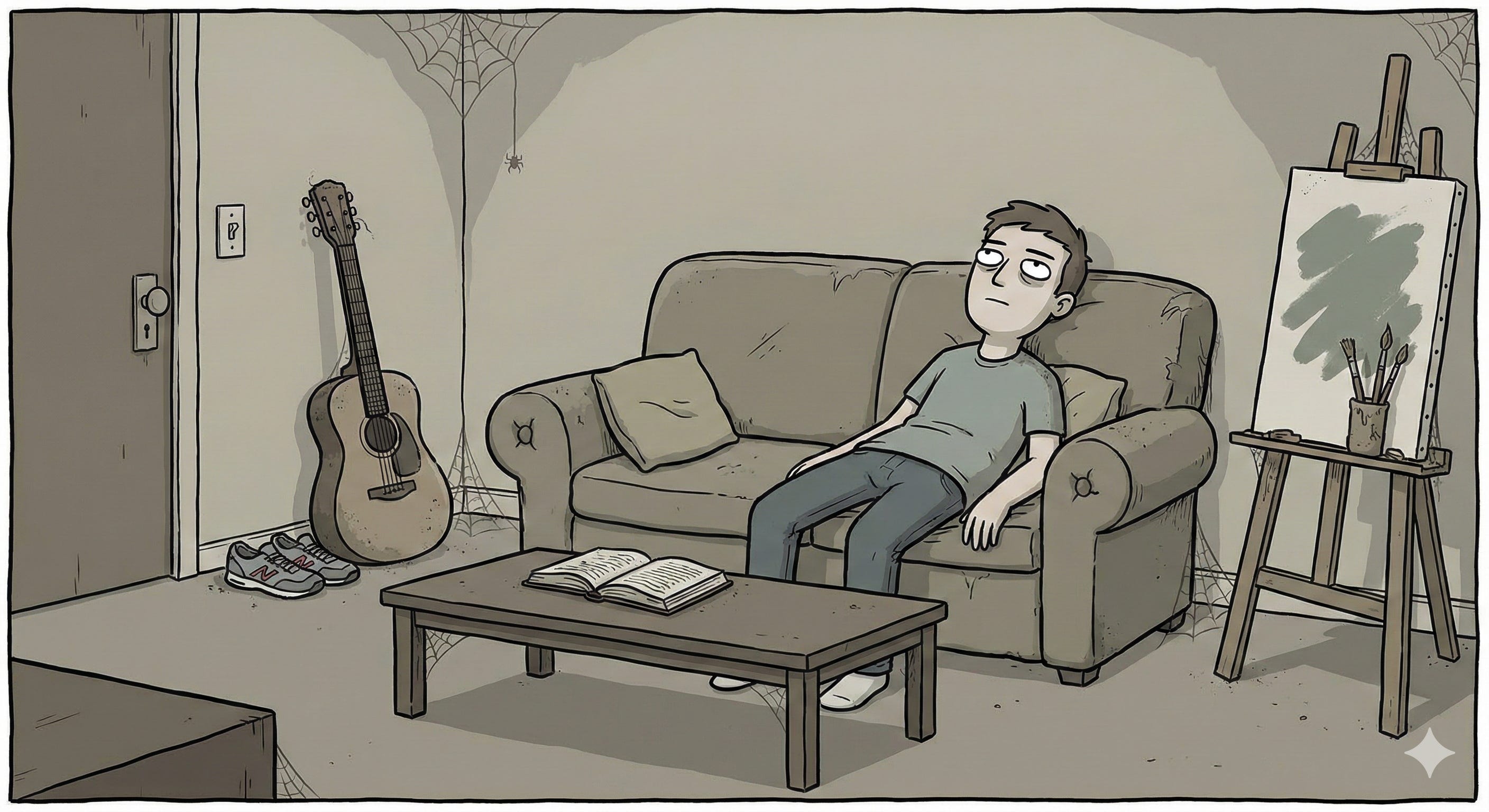
You’re scrolling, but you’re not enjoying it. You know this, and you keep going anyway.
A few years ago the same content might have felt fun. Now it feels flat, but stopping feels worse - and it’s not just your phone. Books, cooking, exercise, anything that requires effort to start has become harder.
The underlying mechanism is a measurable change in your brain’s reward chemistry, and it starts with how your phone delivers dopamine.
Your Phone Produces Unnaturally Frequent Dopamine Spikes
Dopamine is what drives you to keep looking for rewards. The biggest spikes come from surprises - you check something without knowing what's there, find something good, and your brain stamps in the lesson: do that again.
This wiring exists because it kept our ancestors alive. The ones who got a chemical hit every time they found unexpected food kept checking every bush and every stream. They found more, survived longer, and passed the instinct down. (I wrote a deeper breakdown [here])
Tech companies exploit the same mechanism. Every feed-based app is engineered so that most content is forgettable, but occasional posts deliver a genuine hit - and that’s exactly what keeps you scrolling through everything else.
But a feed never runs out. So a signal that evolved to fire a few times a day now fires hundreds of times, for months and years.
Repeated Dopamine Surges Dull the Receptor System That Receives Them
You know how you stop noticing a smell after a few minutes in a room? The smell hasn’t faded. Your receptors have adjusted to it, so the same concentration no longer registers.
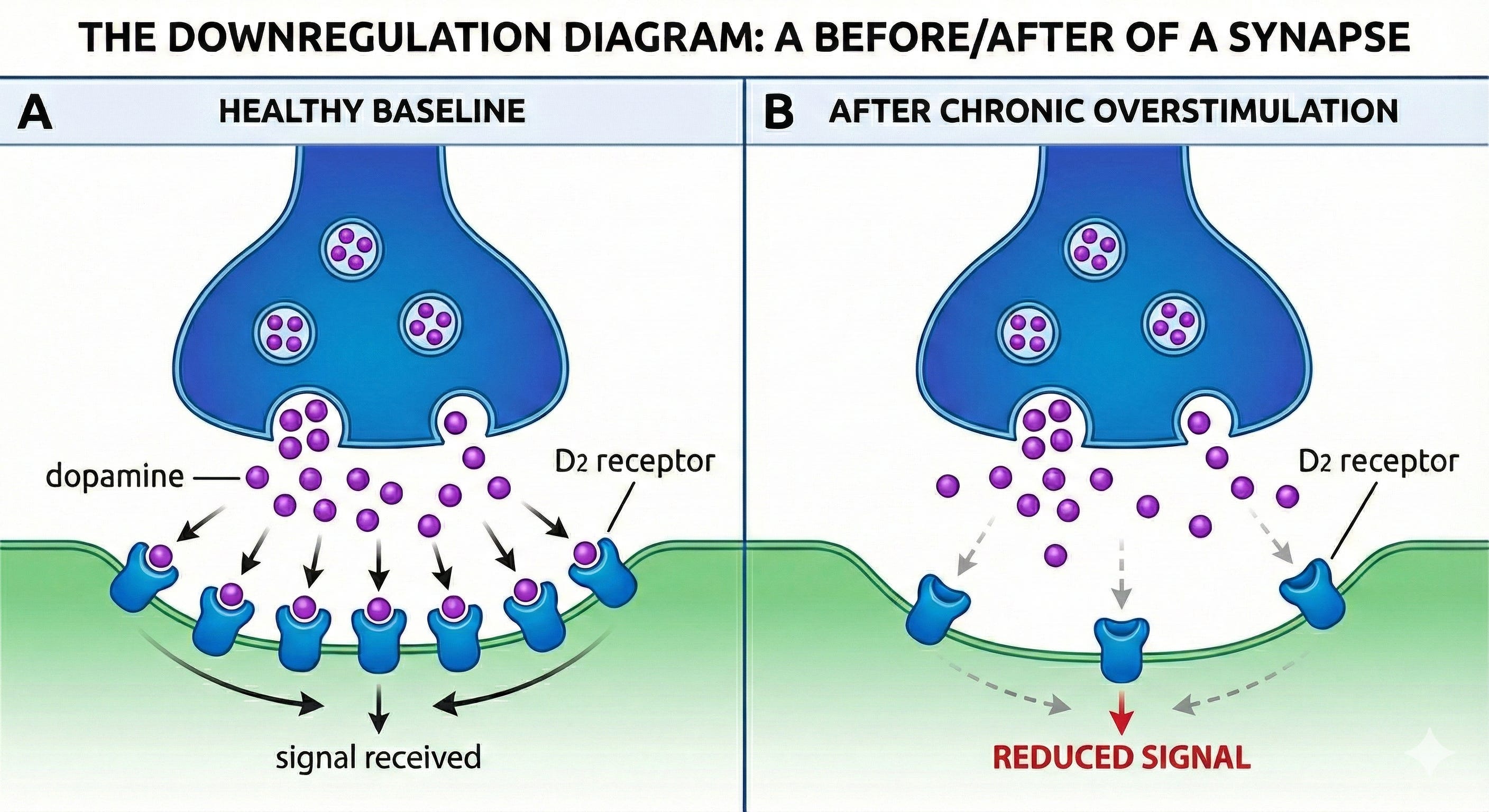
The same thing happens with dopamine. When the striatum (the brain’s reward-processing hub) gets flooded with dopamine repeatedly, its neurons start removing the receptors that pick up the signal. This is called downregulation. The dopamine is still being released. There are just fewer receivers left to detect it.
This is why the same content that entertained you a year ago now feels flat. The dopamine it produces hasn't changed. Your brain's ability to register it has.
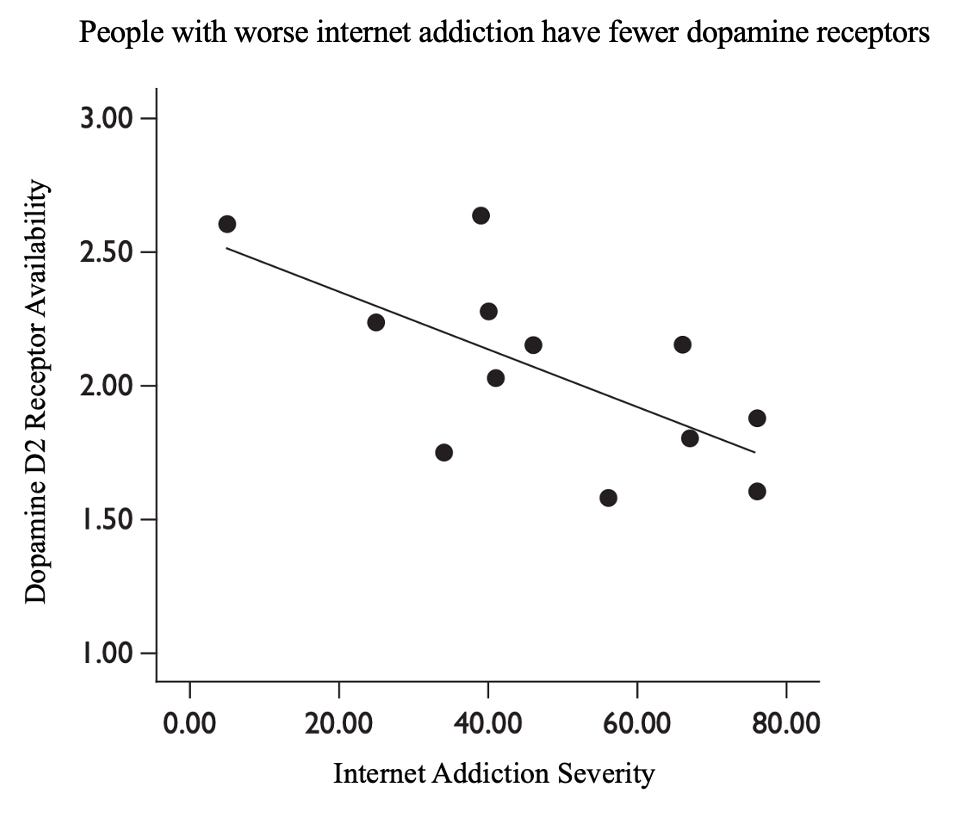
Brain scans of people with internet addiction confirm this. The more severe the addiction, the fewer dopamine receptors remain. The same pattern appears in cocaine, methamphetamine, and alcohol addiction - the substance changes, but the receptor loss looks identical.
Dopamine Receptor Loss Weakens the Prefrontal Cortex
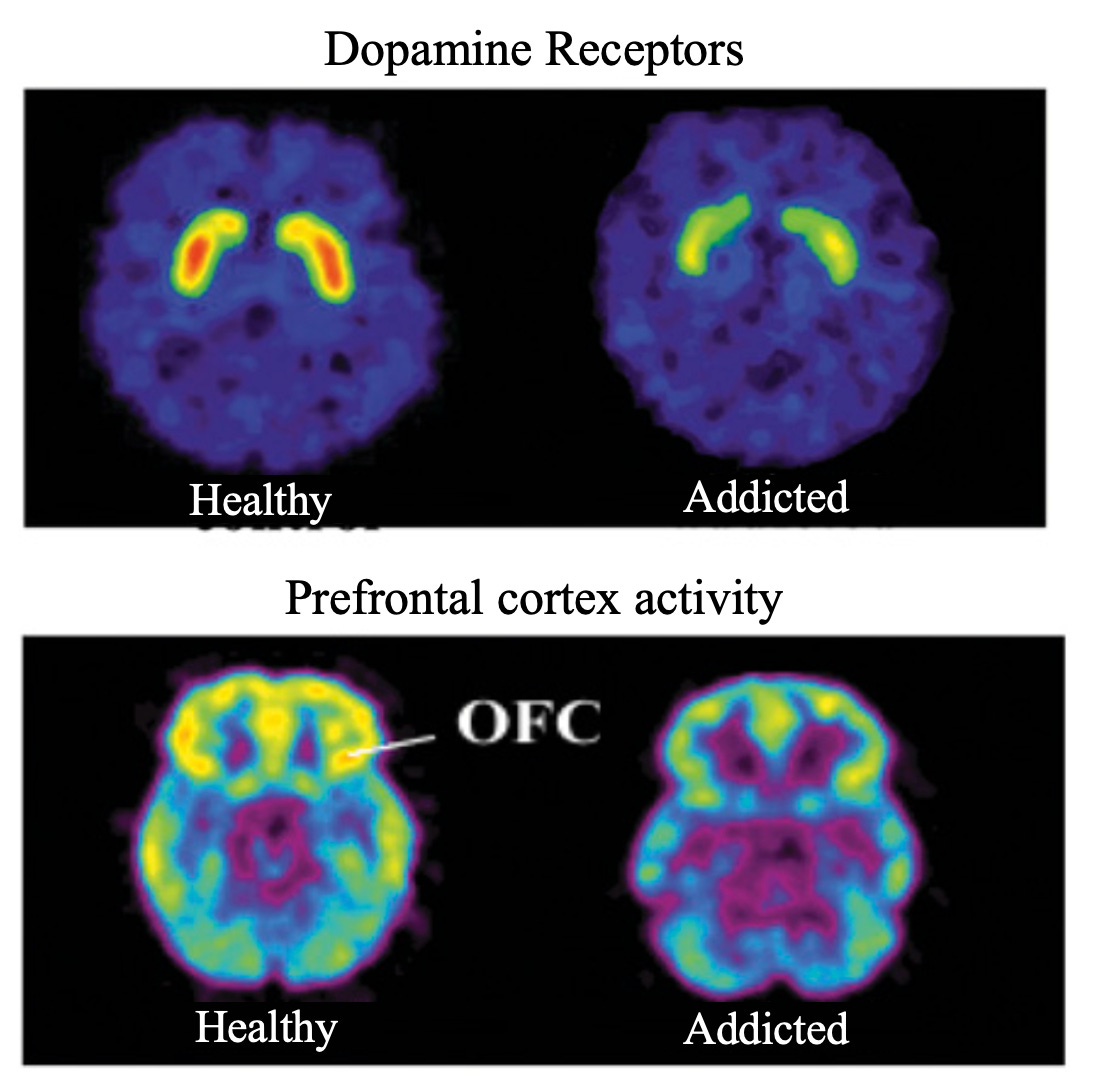
When receptors are lost, everyday rewards - a meal, a conversation, a walk - register more weakly. But these receptors also directly regulate activity in the prefrontal cortex, the region responsible for deliberate choices.
This means receptor loss both dulls your experience of normal rewards and weakens your ability to choose them over scrolling.
Researchers at the National Institute on Drug Abuse showed this by scanning the brains of addicted and healthy subjects. They identified that both the receptor levels (top row) and prefrontal activity (bottom row) are visibly dimmer in the addicted brain.
Three specific areas were affected:
The orbitofrontal cortex assigns value to your options. With reduced activity, your brain overweights the quick hit of opening your phone and underweights the slower reward of finishing a book or cooking a meal.
The anterior cingulate cortex controls your ability to stop a behaviour you’ve already started. This is the region that fails when you tell yourself "one more video" for the fifth time and genuinely cannot make yourself close the app.
The dorsolateral prefrontal cortex handles planning and decision-making. When it's underactive, your brain skips the thing you planned to do and defaults to whatever is easiest to start - which is almost always your phone.
This is what makes the problem self-reinforcing. The receptor loss weakens the exact brain regions you would need to change the behaviour causing it.
And Dopamine Fasts Make the Problem Worse
The most popular advice is to cut off all stimulation for a weekend and let your receptors reset. It sounds logical, but:
Receptors don’t rebuild that fast. Growing new receptors is a slow biological process - weeks to months. A weekend of abstinence changes nothing structurally.
Fasting amplifies cravings. Research on addiction shows that the urge to seek a reward escalates during total abstinence, peaking around weeks two to four. So by the time the fast is over, the pull towards your phone is stronger than when you started - you scroll more, feel guilty, try another fast, and repeat.
Instead, recovery that works has three stages: reduce the stimulation, rebuild the receptor system, and strengthen the prefrontal cortex that was weakened alongside it.
How to Reverse the Process
Stage 1: Environmental Friction Reduces Dopamine Hits Without Requiring Willpower
Every time you scroll, your striatum gets another hit of dopamine, and the pressure to remove more receptors continues. The first step is to reduce how often that happens - not through temporary abstinence, but by permanently making the behaviour harder to start.
Environmental friction solves this by adding external barriers that prevent the behaviour before your prefrontal cortex needs to get involved. A 2022 trial testing friction-based strategies found that smartphone addiction scores dropped by 20% and held for at least six weeks.
The most effective changes: