


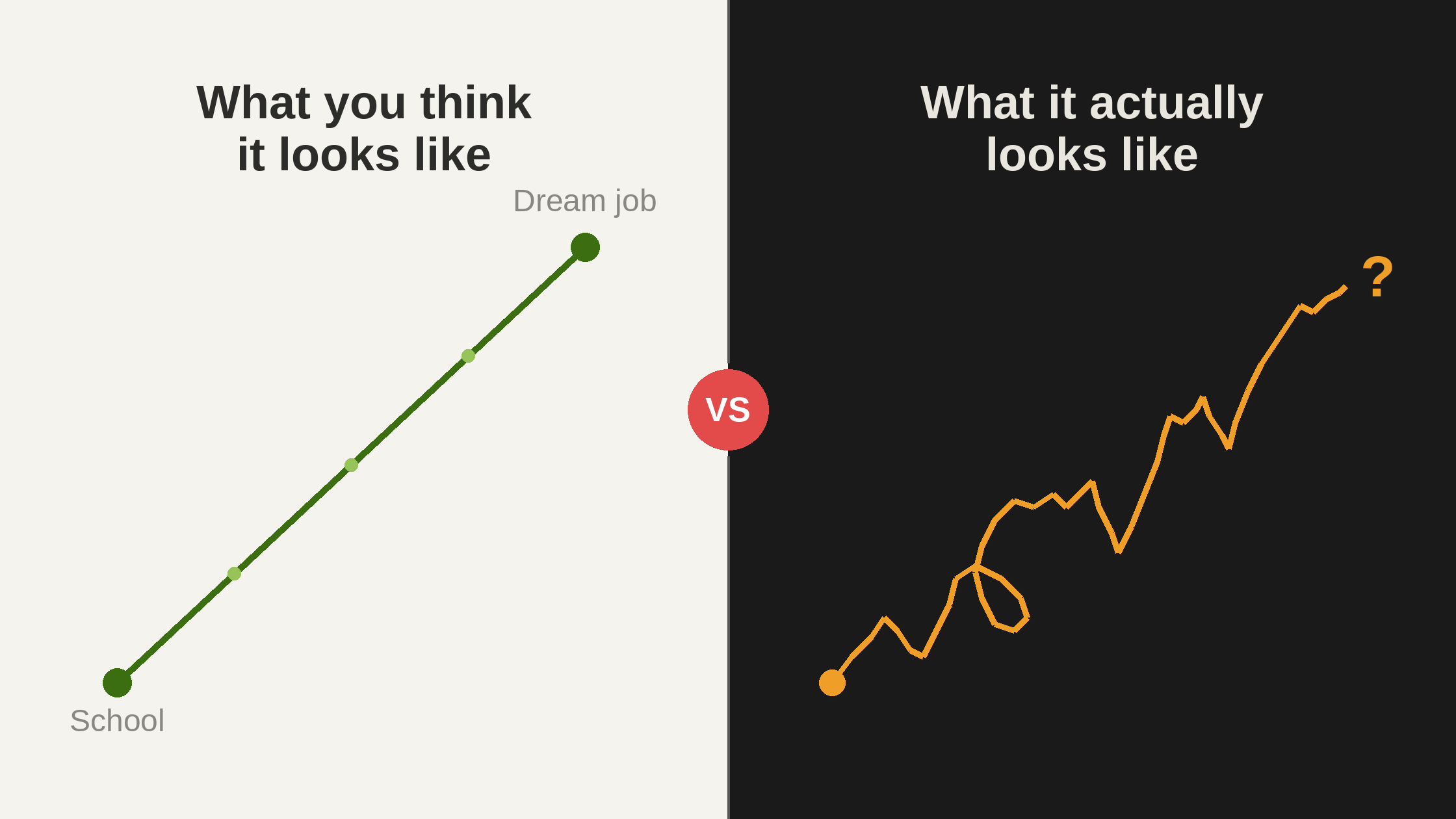
“What should I do with my life?”
You’ve probably asked yourself this more than once. You might have even found an answer. Maybe several. But none of them stuck in the way you expected them to.
That’s because the question comes with a hidden assumption: that there’s one thing out there with your name on it, and once you find it, you can reverse-engineer how to get there.
Pick the destination, map the route, execute.
And that makes sense. Because surely that’s how you got to where you are today? You can look back right now and trace the line. You picked that subject, which led to that opportunity, which introduced you to that person, which led to the job, which led to here.
So obviously the move is to do that again, but on purpose this time. Right?
Your Brain Builds the Story Backward, And You Mistake it For A Plan
The problem is that clean line you see when you look back? It didn’t exist while you were living it. You didn’t experience those years as a sequence of deliberate, connected choices. You experienced them as a series of “I guess I’ll try this,” and “well that didn’t work,” and “huh, this is interesting.”
Your brain just took all of that mess, edited out the dead ends, and presented you with a highlight reel that feels like intention.
You can actually measure how wrong we get this:
When 19,000 people were asked to predict how much their personality, values, and preferences would change over the next decade, every age group thought they'd change far less than they actually did.
Only 27% of college graduates work in a job related to their major.
The average person holds 12 jobs over their lifetime and changes careers entirely 5 to 7 times.
53% of workers use half or less of their education in their current job - 15% use none of it.
This is what your brain does. It makes meaning backward. And it’s good at it - so good that the story it tells feels like it was always the plan. You look at the path behind you and think I chose this. But mostly, you stumbled into it and your brain cleaned it up later.
And this is precisely why “what should I do with my life?” is such a suffocating question. You’re trying to write the retrospective story before you’ve lived it - to see the path forward with the same clarity you have looking back.
Which raises an obvious question: if not a plan, then what?
You Don't Need a Blueprint. You Need a Garden
Think about how a garden actually works. A gardener prepares the soil, chooses what to plant, waters it - and then they’re in a negotiation with forces they don’t control. The light is what it is. The soil has its own chemistry. Some things take and some don’t.
What separates a good gardener from someone who just follows the instructions on the seed packet? They watch. They notice the thing in the corner that’s thriving despite being neglected, and the thing front and centre that’s failing despite all the attention. Then they act on what they see instead of what they planned. They move the thriving thing into better light. They pull out the failing thing even though they already paid for it.
Take Stewart Butterfield. He spent years trying to build a massive multiplayer online game. It flopped. But during development, his team had built a small internal tool to communicate with each other.
That tool became Slack - a billion dollar company.
The crazy thing is he’d done this before. Years earlier, Stewart Butterfield’s first attempt at a multiplayer game also failed - but the photo-sharing tool the team built on the side became Flickr.
He didn't get there by following a plan. He found it by paying attention to what was actually working while the thing he'd planned was dying.
So what can I actually do?
I've spent a long time looking at the research on this - how people end up in work they love, what they actually did to get there. It comes down to four things.