


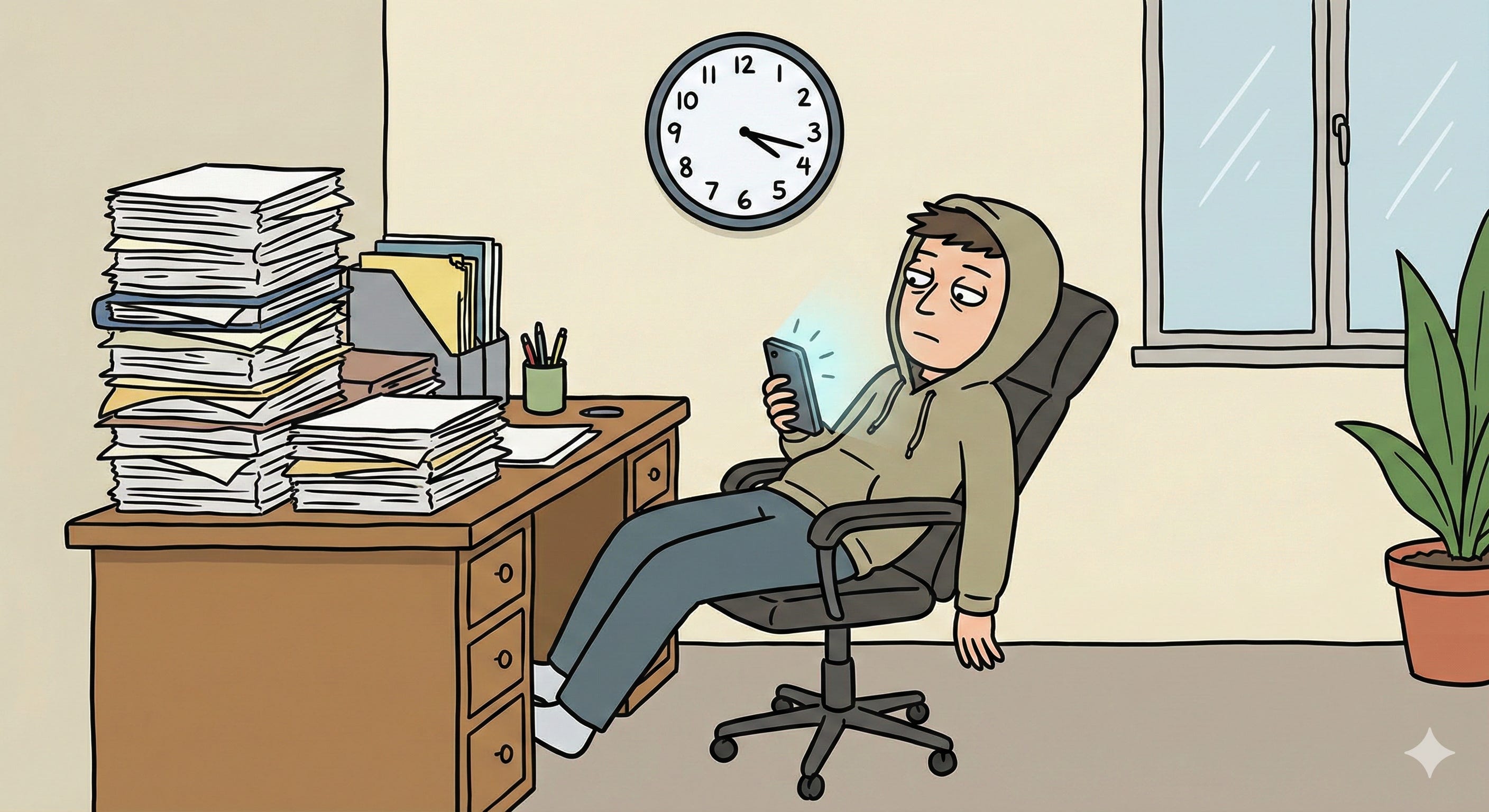
Sometimes you want to do a task, you know how to do it, and you still don’t start doing it. This is more common than it sounds, and it’s usually not a motivation problem or a question of knowing what to do.
The reason is that wanting, knowing how, and starting are three separate things, handled by different parts of the brain. You can have the first two fully in place and still be stuck on the third - the actual switch from not doing the task to doing it.
So how does that work?
By default, your brain keeps every action held back.
Deep in the brain sits a group of structures called the basal ganglia. One of their main jobs is to keep possible actions switched off. At rest, they suppress almost everything you could be doing, and the state they enforce is to stay put.
In mechanical terms, what this means is that starting a task is the removal of suppression. The action is already prepared; beginning it just means the cells holding it back stop firing. The switch that "starts" something is really a switch that stops blocking it.
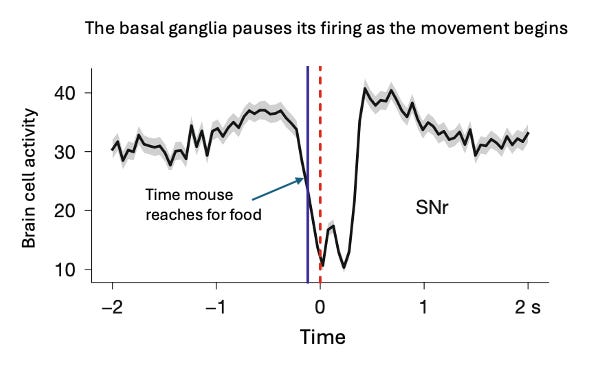
If that's right, the suppression should switch off at the moment a movement begins - which is what a 2025 Nature paper found. Researchers watched a mouse reach for a piece of food while recording its brain, so they could line up these cells' activity with the moment it moved. They found that:
The cells go quiet exactly when the mouse moves. They fire nonstop, then switch off the moment it reaches for the food, and start back up once the reach is done.
But if you force the cells to stay active, the mouse moves much slower. While these cells are active, the mouse waits - that's what their firing does, it keeps the movement from happening. Keep them active and the wait just keeps going: the longer they're on, the later the mouse moves.
That's in mice, though.
The natural question is whether this region matters the same way for starting in people. You can't answer this by running an experiment - ethics boards take a dim view of switching off someone's ability to stand up and timing the result.
But it turns out you don't need to. Some people already live with damage to this part of the brain, usually after a stroke or a loss of oxygen.
Humans with brain damage in this region struggle to initiate tasks
Two French neurologists, Dominique Laplane and Bruno Dubois, studied patients like this and described the condition in 2001. Left to themselves, these patients did almost nothing - one could sit in a chair for hours without starting anything.
The striking part was that their ability stayed intact. As soon as someone prompted them, they acted without any trouble. The problem was solely with their ability to initiate tasks. What this tells us is that the ability to start runs on different brain machinery than doing it, because damage to one region can take out the starting while leaving everything else working.
Now procrastinating on an email isn't the same as the condition these patients had - one's severe brain damage, the other's a Tuesday. But the thing that got these patients moving is worth stealing anyway: a prompt from outside. And if an external nudge is enough to start someone whose brain is actually damaged, it's probably more than enough for you and me.
How to Actually Start Doing Things:
The difficulty is always in the same place: the switch from not working to working.
Deciding to begin is slow and easy to stall on, so the tactics below skip it. Each one either gets you started using an outside cue, or makes the first step small enough that beginning barely counts as a decision.