



The idea that your gut affects your mood has moved from fringe to mainstream. Probiotic supplements are now a multibillion-dollar market, much of it aimed at stress and low mood.
The connection is real, and researchers have mapped much of how it works. Those details also explain why the specific product matters so much - and how to find one worth trying.
Depression often comes with an inflamed brain
In many people, depression involves inflammation in the body and the brain.
People with depression are measurably more inflamed. A pooling of 107 studies and more than 10,000 people found higher levels of inflammatory proteins such as C-reactive protein and interleukin-6 - the same markers that rise during an infection.
That inflammation reaches the brain itself. Brain scans showed the brain’s immune cells were more active during a depressive episode, and the most active brains belonged to the most severely depressed patients.
Inflammation can come first, and depression follows. A hepatitis C drug that triggers a strong immune response caused clinical depression in about one in four patients, usually within the first weeks.
Inflammation doesn't explain every case. But it shows up often enough that researchers treat it as a real part of the illness.
Your gut helps set how inflamed your brain is
Your gut bacteria send a constant stream of signals toward the brain, and many of them turn its inflammation up or down.
The clearest of these is butyrate, a molecule certain gut bacteria make when they digest fiber. Butyrate keeps the brain’s resident immune cells healthy and properly regulated, and helps seal the barrier that protects the brain from the bloodstream. Furthermore, people with depression tend to have less butyrate in their blood, and those who start with more are likelier to recover.
But butyrate is only one messenger.
Gut bacteria also fire the vagus nerve - the direct wire running from gut to brain - using a mix of compounds including short-chain fatty acids, bile acids, and others. And a 2024 study traced depression in mice to a single gut bacterium and the specific molecules it produces, which tip the balance of inflammation-related signals reaching the brain.
The common thread is simple: what your gut bacteria make ends up shaping how inflamed your brain is. Which means changing those bacteria - with probiotics, or with what you feed them - is a way to alter that inflammation.
The trials say they help - but the picture is messy
Probiotics reduce depression on average - and the reason results vary so much is that no two trials used the same bacteria.
Each trial below tested a different strain, at a different dose, for a different length of time.
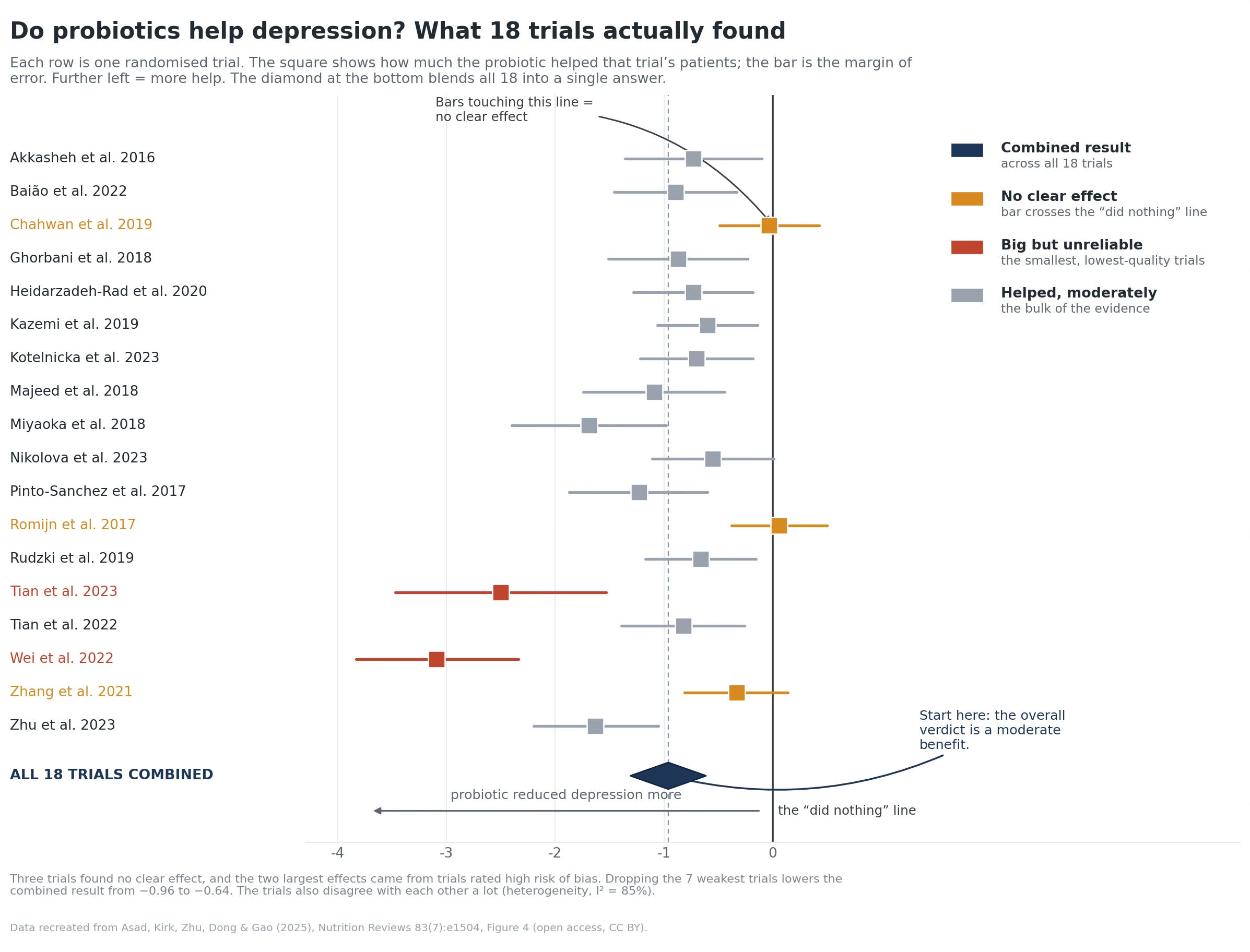
The trials that worked best used specific, well-studied strains at real doses. The ones that fell flat often used different bacteria, or too little, or ran only a week or two.
So probiotics can clearly help - but the benefit often depends on what’s actually in the bottle.
Two bottles labeled “probiotic” can do completely different things
A probiotic’s effect depends on the exact strain, and different products contain entirely different ones.
Each strain does a different job - one calms inflammation, another produces butyrate, another barely interacts with you at all. A benefit proven for one strain doesn’t transfer to a bottle of different bacteria.
That’s why the label matters more than the word “probiotic.” Everything you need to tell a promising product from a pointless one is printed right on it.
Below, how to read the label - and the six things worth checking before you buy.