



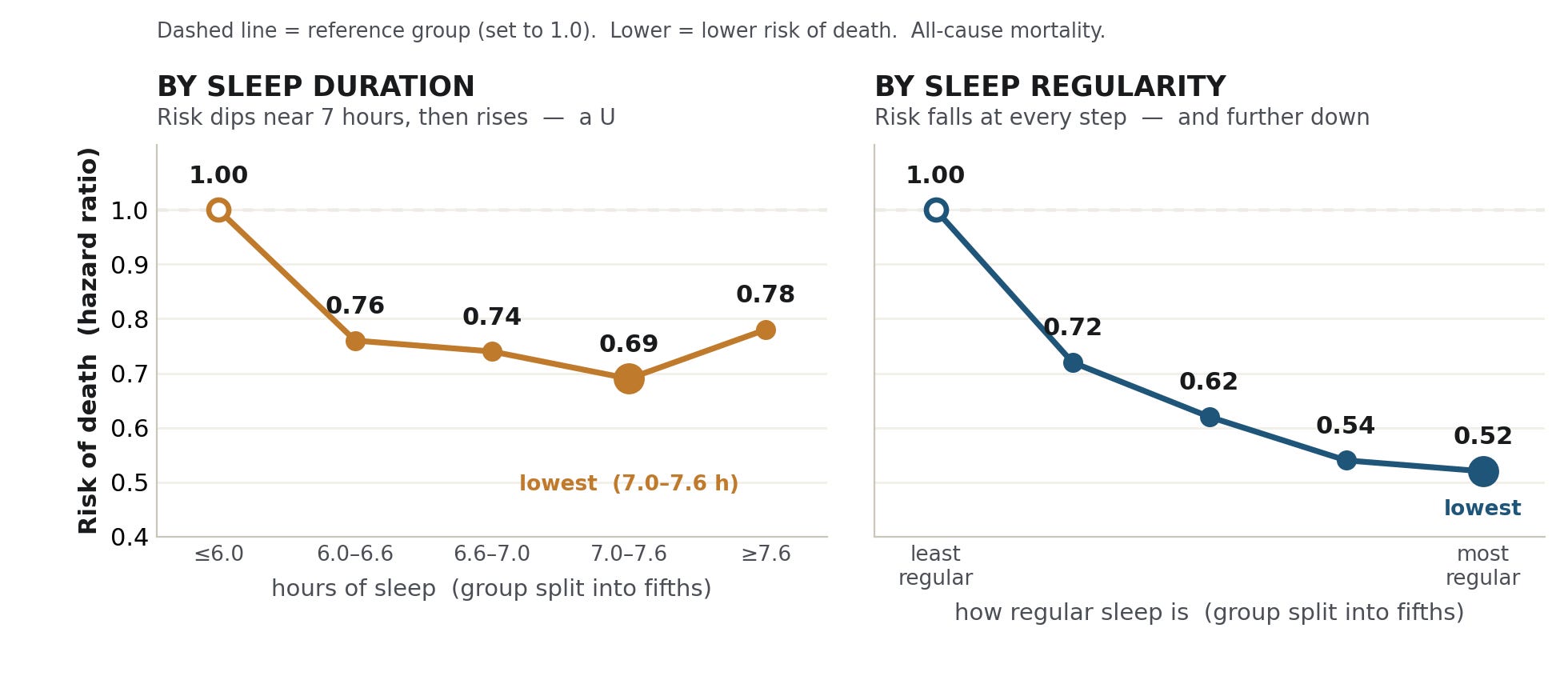
For a long time, sleep advice has focused on hours. Major guidelines recommend seven or more hours a night, typically seven to nine for most adults. They also warn that both too little and too much sleep are linked to worse health and earlier death. But newer research points to something else: how regular your sleep is. One large study suggests it predicts how long you live better than the number of hours you sleep.
Regular sleep means falling asleep and waking up at about the same times each day. In that study - nearly 61,000 adults who wore movement trackers for a week - the most regular sleepers had about a 20% to 48% lower risk of death from any cause than the least regular. Once the researchers accounted for regularity, adding sleep length told them almost nothing new. It is a single study and shows an association rather than proof, but the gap is large and a steadier schedule is low-risk to try.
The likely reason is a disrupted body clock
Your body runs on an internal clock set to about 24 hours. When your sleep times change from day to day, so do the things tied to the clock, such as when you get light, when you eat, and when you move.
Experiments show that disrupting sleep timing affects three of the main risk factors for heart and metabolic disease:
Blood pressure - the force of blood pushing on your artery walls. When it stays high, it strains the heart and blood vessels.
Inflammation - the body’s response to injury or infection. When it stays active too long, it harms healthy tissue.
Blood sugar control - how well the body keeps blood sugar in a healthy range. Poor control leads to type 2 diabetes.
Animal studies point the same way. When researchers deliberately knock an animal's clock out of sync using light, it develops serious heart disease and dies earlier. That matches what the study found in people: the least regular sleepers were more likely to die from heart and metabolic disease.
So the goal isn’t necessarily more sleep. It is steadier sleep. That should be good news. You cannot force yourself to sleep more hours, but you can usually make your sleep times more regular - and that comes down to a few specific habits. The ones that work best are not the ones most people try first.
What to do
Start by tracking a week
For one week, write down four times each day: when you got into bed, when you fell asleep, when you woke, and when you got up. The pattern shows which problem you have and where to start: