


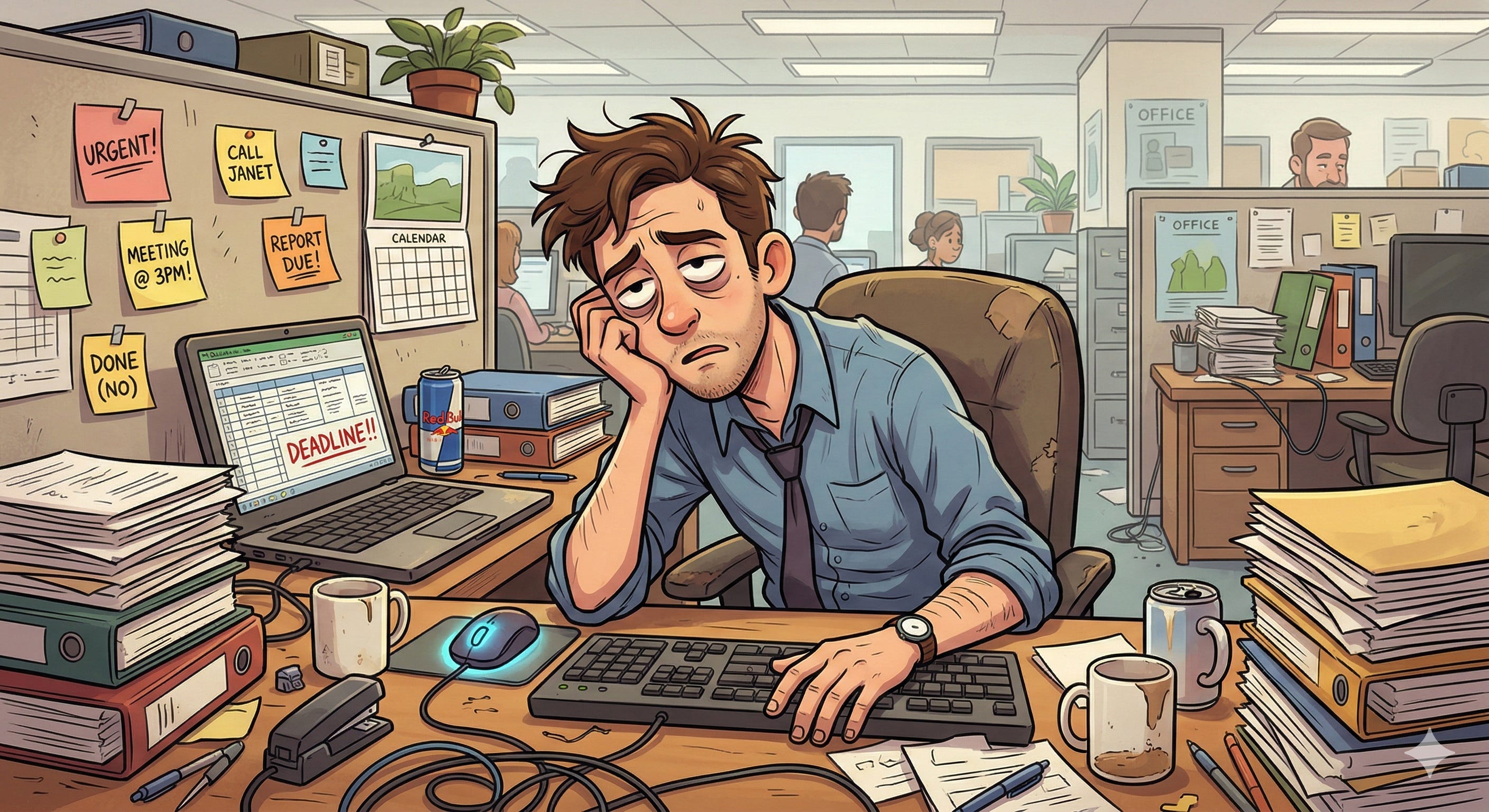
You feel behind all day but can’t point to why. Small things start triggering big reactions. You come home too tired to do anything but too wired to rest. Things that used to recharge you feel like more effort.
This is burnout. And it happens because the way we work now drains your brain faster than the way we rest rebuilds it.
To understand why, look at what actually changed about work in the last twenty years.
Slack, Teams, and Email Added a Layer of Work on Top of Your Actual Work
Over the last two decades, we added low-friction digital communication to the workplace. Email, Slack, Teams. The assumption was that faster communication would only make work better.
And while it did, it also means every commitment we say “yes” to now brings a trail of administrative overhead: emails about the commitment, meetings to discuss the commitment, and constant pings to coordinate the commitment. A task that used to take focused effort now takes that effort plus dozens of messages to coordinate it.
Every message pulls your attention away from what you were doing, and getting back takes time and effort. So you spend most of your day switching between things rather than finishing them. You always feel behind.
And that low-level tension you carry all day - the sense that there’s always something you should be doing - is driven by a hormone called cortisol.
Cortisol Is Designed to Spike and Recover - Chronic Stress Stops the Recovery
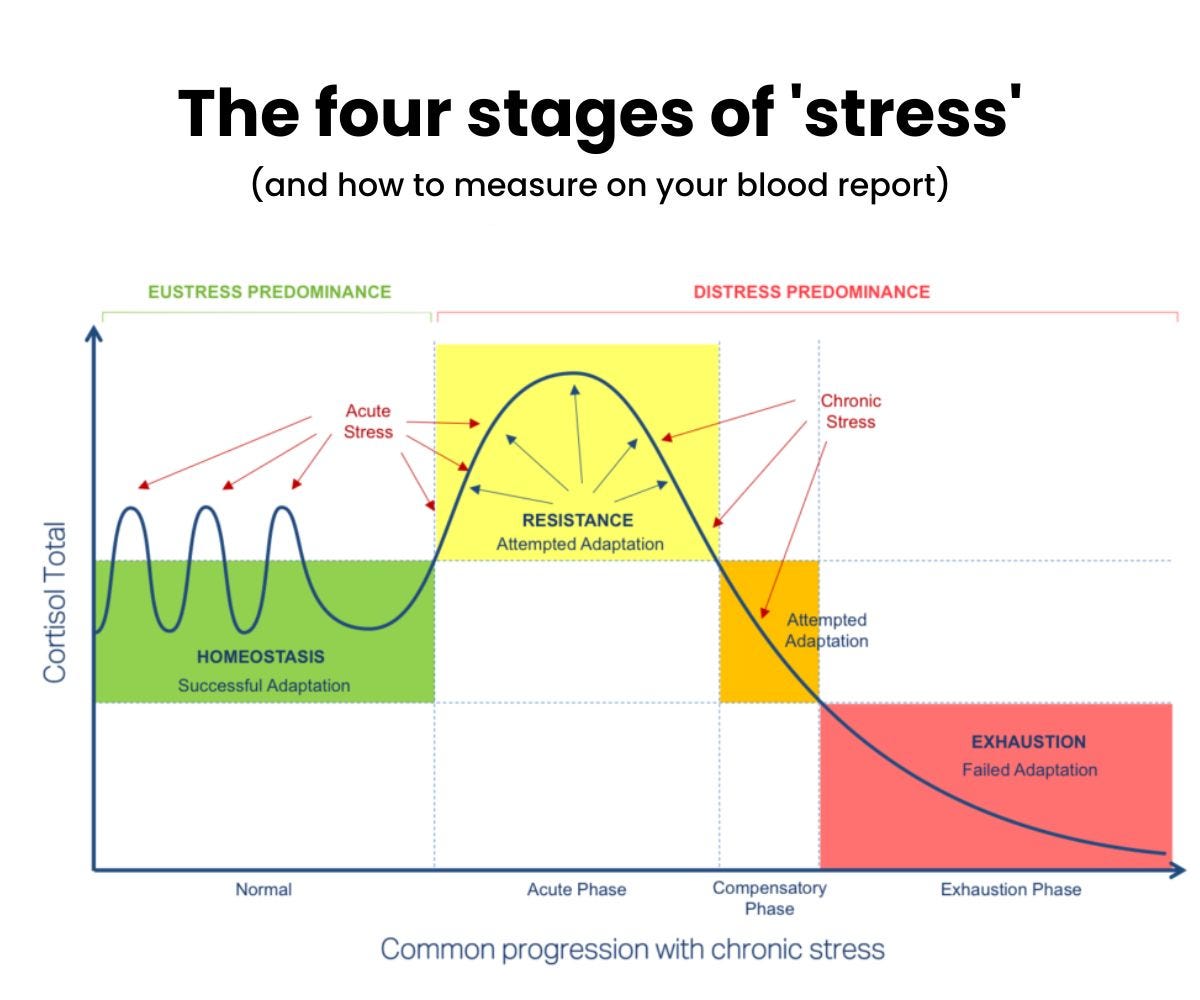
In a healthy body, cortisol follows a rhythm: it spikes when you face a challenge, then drops once the challenge passes. This means you can respond to stress, recover fully, and be ready for the next demand.
But when stress becomes constant, this rhythm breaks down in stages:
Stage 1 - Resistance. The body tries to keep up. It pushes cortisol higher and holds it there, which you can see as the curve climbing steeply upward. You feel wired, on edge, running on adrenaline. You might even feel productive. But the waves are gone. Recovery between stressors is no longer complete.
Stage 2 - Compensatory phase. After months of sustained output, the stress response weakens. You can see cortisol beginning its decline on the graph. You feel both tired and anxious at the same time.
Stage 3 - Exhaustion. Cortisol drops below its original baseline and stays there - the red zone on the far right. The healthy rhythm is gone. Your body can neither mount a full stress response nor fully stand down. This is burnout.
But prolonged cortisol exposure doesn't just exhaust the stress response - it physically changes the brain.
Prolonged Stress Exposure Rewires Your Brain
By the time the cortisol system reaches exhaustion, prolonged cortisol exposure has produced measurable changes in three brain regions:
Your amygdala enlarges. It becomes hyperreactive. Small things - a blunt email, a last-minute calendar change - start triggering full emotional responses.
Your prefrontal cortex thins. Sustained cortisol shrinks the neurons responsible for planning and impulse control. Goals stop generating drive. Decisions that used to be automatic feel paralysing.
Your striatum shrinks. The striatum tags experiences as worth pursuing, and under chronic stress it stops producing the dopamine signal that says “do this again.” Activities that once brought satisfaction feel like effort for nothing. You stop enjoying things.
And these three regions don't work in isolation. Normally, the prefrontal cortex regulates the amygdala, and the striatum sends motivational signals to the prefrontal cortex. But under chronic stress, these connections weaken. The amygdala fires unchecked, the prefrontal cortex receives no signal to act, and nothing feels worth pursuing.
How to Recover from Burnout
The good news is these changes are not permanent. The same neuroplasticity that allowed chronic stress to reshape these regions works in reverse. Give the brain the right conditions, and it rebuilds.
Recovery requires two things: reducing the volume of work your brain processes each day, and creating genuine recovery windows so cortisol can come back down.
Reduce the Cognitive Load Your Work Creates
Modern work generates far more cognitive load than the tasks themselves require. Every active commitment brings emails, meetings, coordination, and mental tracking. Reducing this overhead is the most direct way to lower chronic stress.
1. Batch your email and messages into set times
Check email and messages at scheduled times rather than throughout the day. Turn off notifications between them.
Every time you check an inbox, you pull your attention away from whatever you were doing. Getting back to your original task takes time and effort. The more often you check, the more of your day you spend switching between things rather than actually doing them.
A 2015 study of 124 adults found that batching email into three daily windows produced a measurable drop in cortisol compared to checking freely.
2. Set one to three goals for the day
Each morning, look at everything on your plate and pick the one to three tasks that would move your most important projects forward. Ignore everything urgent but unimportant - those can wait or be batched later. Write only those tasks down. Do the hardest one first, while your prefrontal cortex is freshest.
When your to-do list has twelve items, you spend the day half-working on all of them and finishing none. A short list forces you to complete things, and completed tasks are the ones that actually reduce your workload.
3. Write down every unfinished task before you finish work
Before you close the laptop, spend five minutes writing down every open task somewhere you'll see it tomorrow. Then mark the transition physically. Change your clothes. Make tea. Put the laptop in a different room.
Without this, your brain never actually stop working. An incomplete email or a half-done report stays active in your brain, keeping your stress response engaged even while you're on the sofa. This means your cortisol is still elevated because as far as your brain is concerned, the workday hasn't ended.
Writing tasks down and physically changing your environment are both forms of psychological detachment - fully disconnecting your brain from work during off-hours. A meta-analysis of 86 studies found this was the strongest predictor of reduced exhaustion and better sleep.
4. Cap active projects at two or three
Open your task manager or notebook and list every project you’re actively working on this week. If it’s more than three, pick the two or three that matter most. Move everything else into a ‘waiting’ list - visible, but not active.
Every active project carries an overhead tax: the emails, meetings, coordination, and mental tracking attached to any commitment. With two projects, most of your day is deep work. With five, most of your day is overhead - and nothing actually gets finished.
Give Your Stress System Actual Recovery Windows
Cortisol is designed to spike and recover. Burnout happens when the recovery windows disappear - when the signal to stand down never arrives. These strategies create the clear endings your cortisol system needs.
5. Take genuine breaks during the work day
Work in focused blocks of roughly 50–75 minutes, then step away completely for 15–30. Leave the desk. Leave the phone. Walk, stretch, talk to someone, go outside.
Rest breaks improve the quantity of work output by around 5% and the quality by 8%, even after accounting for the lost working time. But studies show the type of break matters. Relaxation and social breaks lower stress. Cognitive breaks - puzzles, reading work material, scrolling the news - make fatigue worse.
A break where your prefrontal cortex is still working is not a recovery window.
6. Replace screen-based evenings with physical or creative activity
Think about the activities that used to absorb you completely - the sport, the instrument, the sketching. Pick one and schedule it for two or three evenings this week.
These activities shift brain activity away from the prefrontal cortex and onto motor, sensory, and creative networks. You're using a completely different part of your brain, and the part that's been overloaded all day gets to recover.
Just 45 minutes of free creative activity lowered cortisol in 75% of participants, regardless of prior experience.
7. Spend 20–30 minutes in nature without your phone
Three times a week, spend twenty to thirty minutes outside. Leave the phone behind.
Without notifications, inboxes, or decisions, your brain gets a stretch of time where nothing is asking for its attention. That’s the recovery window your cortisol system needs.
A 2019 study had participants do exactly this for eight weeks. Salivary cortisol dropped 21% per hour of exposure, with the steepest decline in the 20–30 minute window.
8. Take regular short vacations throughout the year
Most people save their recovery for one big holiday. But the wellbeing benefits of a vacation peak around day eight and fade completely within the first week back at work. By week three, burnout levels have fully returned to where they were before you left.
This means a two-week holiday in August gives you roughly one good week of recovery that doesn’t last. A long weekend every few weeks gives you consistent recovery all year round. And studies suggest what you do during time off matters: physical and social activities predict genuine recovery, while passive screen-based “rest” impairs it.j
The Bottom Line
Here’s what I want you to take away: the brain changes behind burnout are not permanent. They are your brain’s response to an environment that never gave it a clean break. Change the environment - even slightly - and the system starts to recover.
You don’t need to do all eight things on this list. Pick one. The most effective strategy is the one you’ll actually follow through on. And remember: the same brain that got you into this state is fully capable of getting you out of it.
Burnout doesn’t always feel like stress.
Sometimes it feels like guilt…
for not being able to be who you were before.
This explanation of administrative overhead as a hidden source of cognitive load feels especially important right now.
One pattern I keep noticing is that some people experience this shift in work much earlier and more intensely than others — not because they’re less resilient, but because their brains were never designed to operate inside constant coordination environments in the first place.
So the Slack/Teams/email layer doesn’t just add work.
It changes the type of work from focused creation to continuous context-switching.
And for many people, burnout starts exactly at that transition point.
Reducing cognitive load helps — but recognizing which environments your brain actually works well inside can be just as powerful for recovery.