


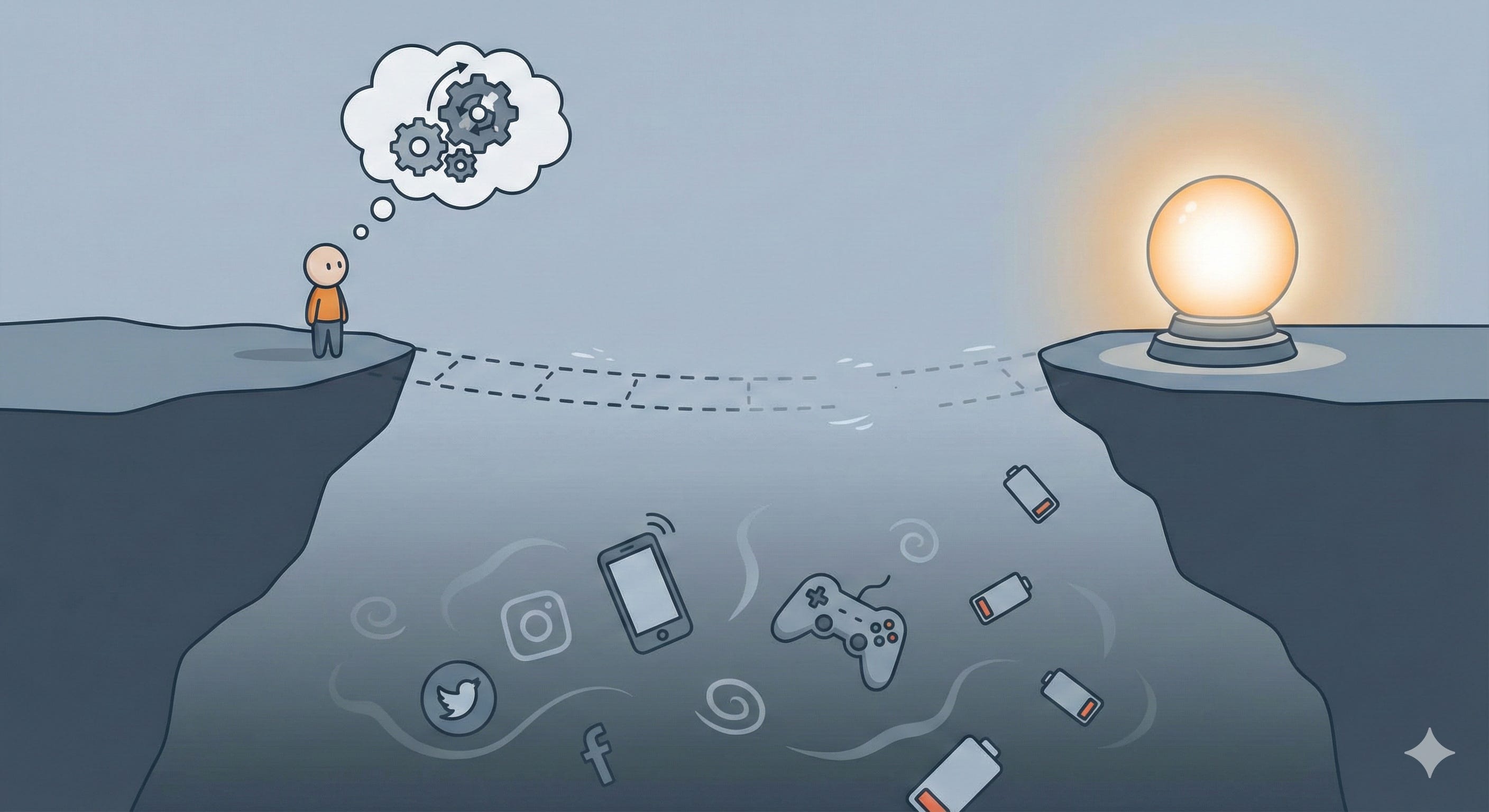
You know the task matters. You want to do it. But you can’t make yourself start.
This isn’t a discipline problem - it’s a dopamine problem. And until you understand what’s actually happening in the procrastinating brain, no amount of “just do it” advice will help.
This article explains why starting feels so hard, and what actually works to make it easier.
Dopamine Drives Motivation, Planning, and Attention
Dopamine is a learning and motivation chemical. It signals three things to the brain:
Start this task.
Stay on this task.
Remember this task was worth doing.
It tells the prefrontal cortex (the area responsible for planning and task initiation) which actions deserve effort.
You can read a deeper breakdown of this mechanism here.
ADHD Creates a Weaker Dopamine Signal
In an ADHD brain, the dopamine system is inefficient. Often, dopamine is removed from the connection between neurons too quickly, or the receptors are less sensitive to it.
This leads to a deficiency in available dopamine in the pathways responsible for task initiation and sustained attention.
To actually start a task, the brain requires a specific threshold of dopamine activity. Because the ADHD brain has a lower baseline availability, it relies heavily on the task itself to release enough dopamine to trigger action.
Routine Tasks Don’t Produce Enough Dopamine
This dependency on the task creates a specific problem for routine work.
Biologically, the brain releases dopamine in response to things that are new, urgent, or surprising. Routine tasks - like emails, cleaning, or paperwork - are predictable and provide none of this chemical spike.
The result is a failure to launch:
The ADHD brain starts with low available dopamine.
The routine task releases very little additional dopamine.
The combined signal is not strong enough to activate the “start” command in the prefrontal cortex.
The Brain Compensates by Seeking High-Stimulation Tasks
Because routine tasks don’t register strongly, the ADHD brain naturally gravitates toward things that produce a bigger dopamine signal:
Urgency (immediate deadlines)
Novelty (new ideas or environments)
Challenge (difficult problems)
Intense Interest (passion projects)
These inputs temporarily strengthen the motivational pathway, which is why people with ADHD often perform well “last minute,” or hyper-focus on engaging tasks with no effort at all.
Logical Importance Cannot Override a Chemical Gap
This biological mechanism explains a common misunderstanding: Logical importance implies a cognitive priority, not a chemical one.
Understanding that a task is important (”I need to file this,” “The deadline is tomorrow”) is a cognitive process. However, this cognitive recognition does not trigger the release of dopamine required to initiate movement.
This is why people with ADHD often say:
“I want to start. I just can’t.”
Put simply, the goal isn’t to convince yourself the task matters. The goal is to create the kind of stimulation your brain can respond to.
How to Work With the ADHD Brain (8 Science-Based Strategies)
That’s where the following strategies come in. They work not by forcing willpower, but by designing tasks in a way that activates the ADHD brain: by increasing stimulation to boost the dopamine signal, while simultaneously decreasing friction to make starting feel effortless.
Before You Start: Two Important Principles
Work With Your Energy, Not Against It
Motivation in ADHD is not constant:
Identify your high-energy windows. Schedule hard tasks there.
Use low-energy periods for routine work.
If you’re stuck in a low phase, shift your state before trying to work.
Change One Thing at a Time
Changing only one habit at a time creates success. Too many changes are overwhelming. Pick one strategy. Use it until it feels natural. Then add another.