


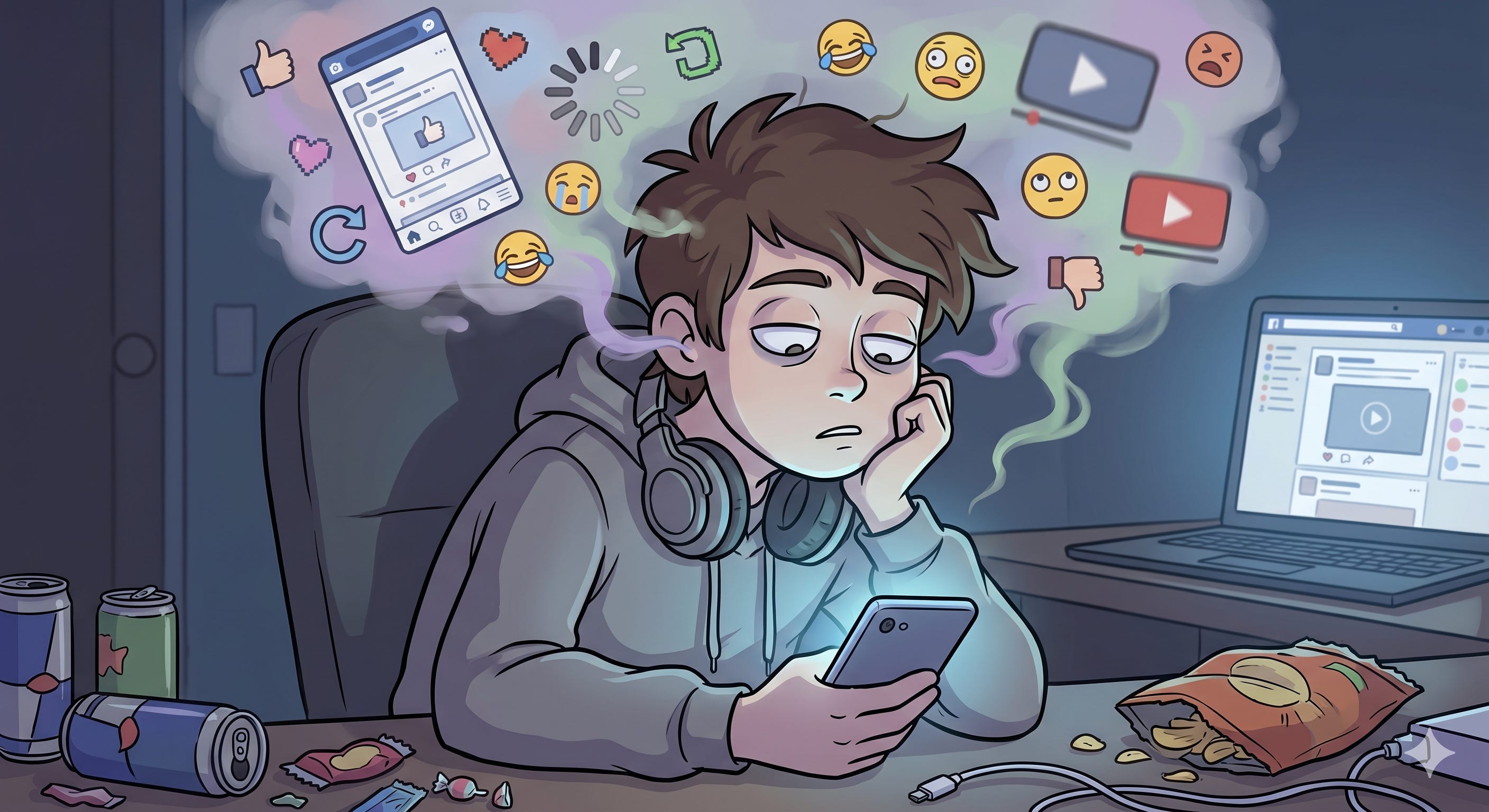
You feel dumber than you used to.
Not in a way you could prove. But you probably notice it. You re-read the same paragraph three times before anything sticks. You pick up your phone to check one thing, lose twenty minutes, and can’t remember what the original thing was.
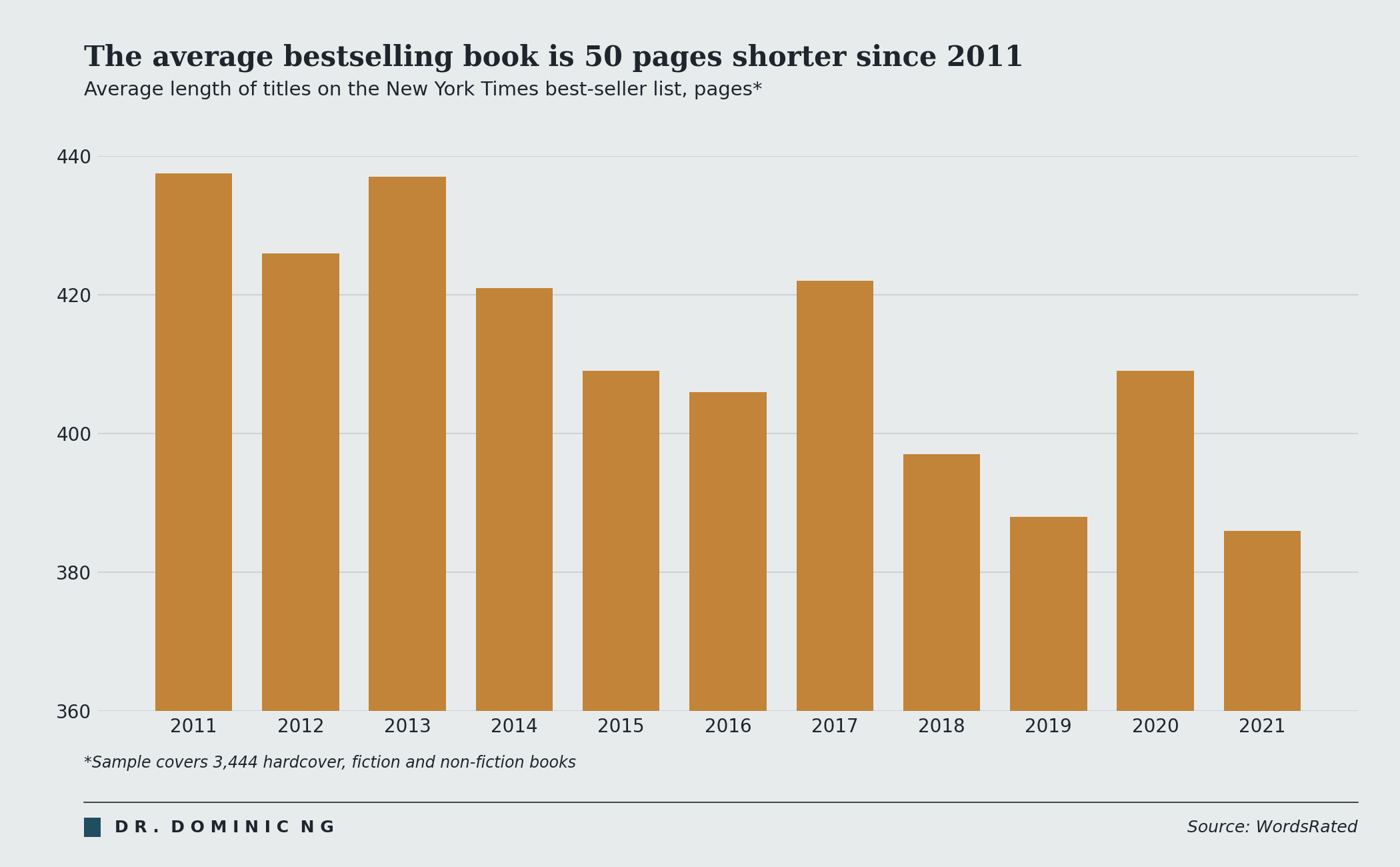
The feeling isn't just yours, and it isn't just a feeling. Look at what people are actually willing to read. The average New York Times bestseller has lost about fifty pages since 2011 - publishers and readers, collectively, converging on shorter books.
The harder measures also show the same drift. Adult literacy and numeracy scores have fallen across most rich countries since 2012, according to OECD testing of more than 160,000 adults across 30 countries. In some, the average adult now scores worse than the average adult did a decade ago - by a margin equivalent to a couple of years of schooling.
Two different measures of two different things, and the windows line up. Something changed in the early 2010s.
There’s an obvious suspect. Smartphones crossed majority adoption in rich countries right in that window, and short-form feeds became the default way people spent their downtime. Plenty of people have drawn the conclusion this invites: our phones are making us worse at thinking.
But does the evidence really back that up?
Short Scrolling Sessions Measurably Weaken Understanding
We already know from correlational studies that heavy social media users have worse attention, but they can’t separate cause from effect. People who already struggle to focus may simply be the ones drawn to apps or phones. The only way to actually test this is to take people, have some of them scroll and some of them do something else for a fixed amount of time, and measure the difference afterwards.
That is roughly what a 2024 study did.
What this study found was that people who spent 30 minutes scrolling TikTok did worse on a test of reasoning and were more likely to believe fake headlines than people who'd spent the same time reading an e-book.
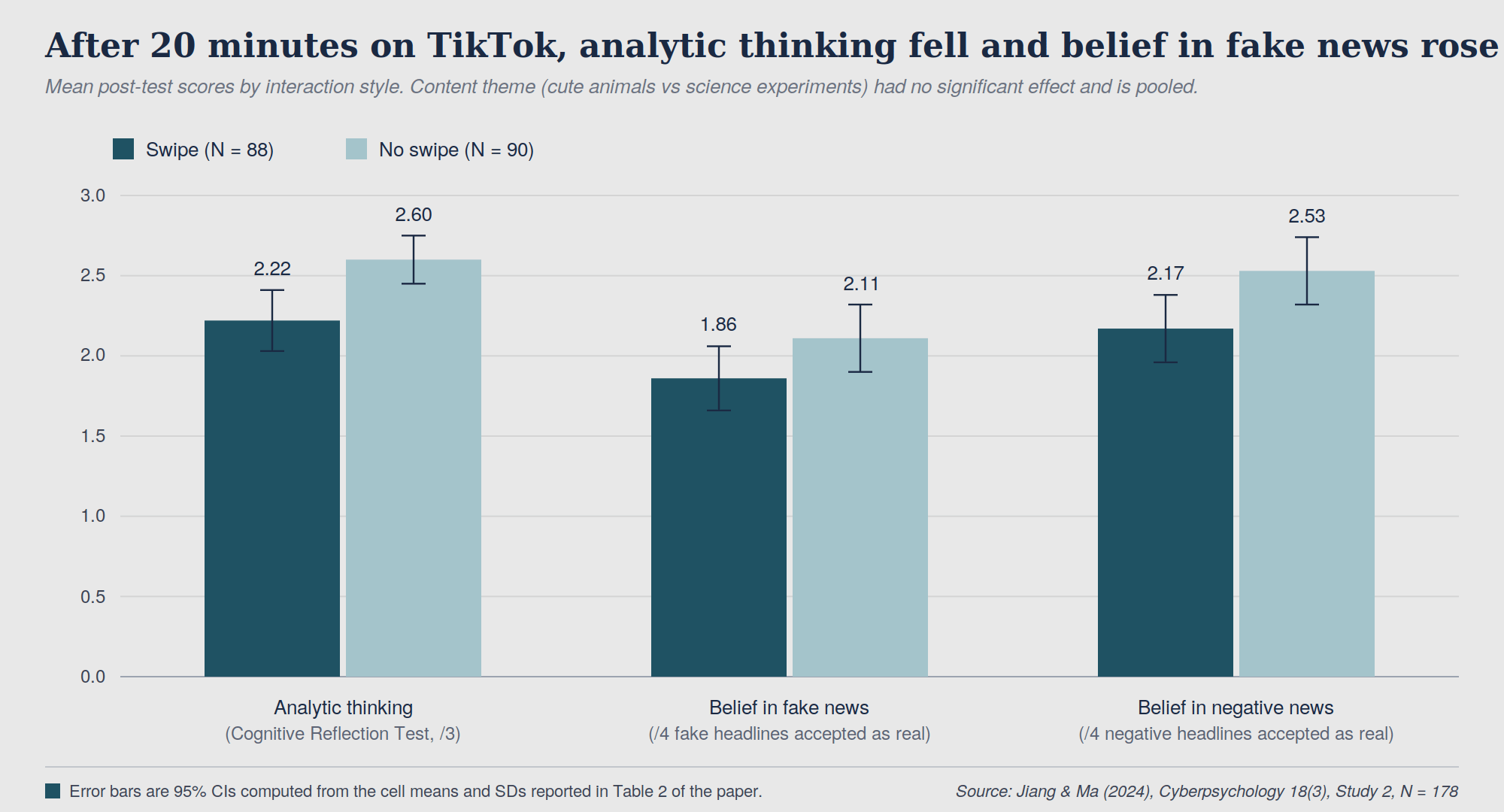
What’s more interesting is they also found that the swiping itself was the problem. Researchers took 178 people and split them in two: one group swiped through TikToks for 20 minutes like they normally would, while the other group watched the exact same videos stitched together into one continuous clip.
Afterwards, the swipers:
Scored noticeably worse on a reasoning test
Were more likely to fall for fake news
Were more likely to believe negative headlines
But if the swiping was the problem, why would that be?
Here are two plausible explanations
Decision fatigue. Every video forces a small choice: keep watching, or move on? Make hundreds of those choices in thirty minutes and you've burned through the mental energy you needed for the reasoning test.
Dopamine adjustment. Each new video gives you a small novelty hit, and your brain adjusts its baseline downward in response. After the session, ordinary tasks feel duller and harder to engage with - not because they've changed, but because your baseline has.
The Good News
The damage isn’t permanent. The experiments measure what happens in the thirty minutes after you put the phone down - not a week later. The scrollers weren’t permanently worse at reasoning; they were just worse for a while.
But “for a while” still costs you. Three hours a day in a fog is three hours a day you’re not thinking clearly, and a lot of life happens in those hours.
Quitting is hard to sustain. Time limits get ignored. Deleting the apps works for a few days, then you reinstall them. But the two mechanisms behind the fog each point to something that does work:
Decision fatigue scales with how many “keep watching?” choices you make. So make those decisions once, upfront - not hundreds of times when you’re tired.
Dopamine adjustment takes thirty to sixty minutes to recover. So put a buffer between scrolling and anything that needs focus.
Here’s how to do both.