



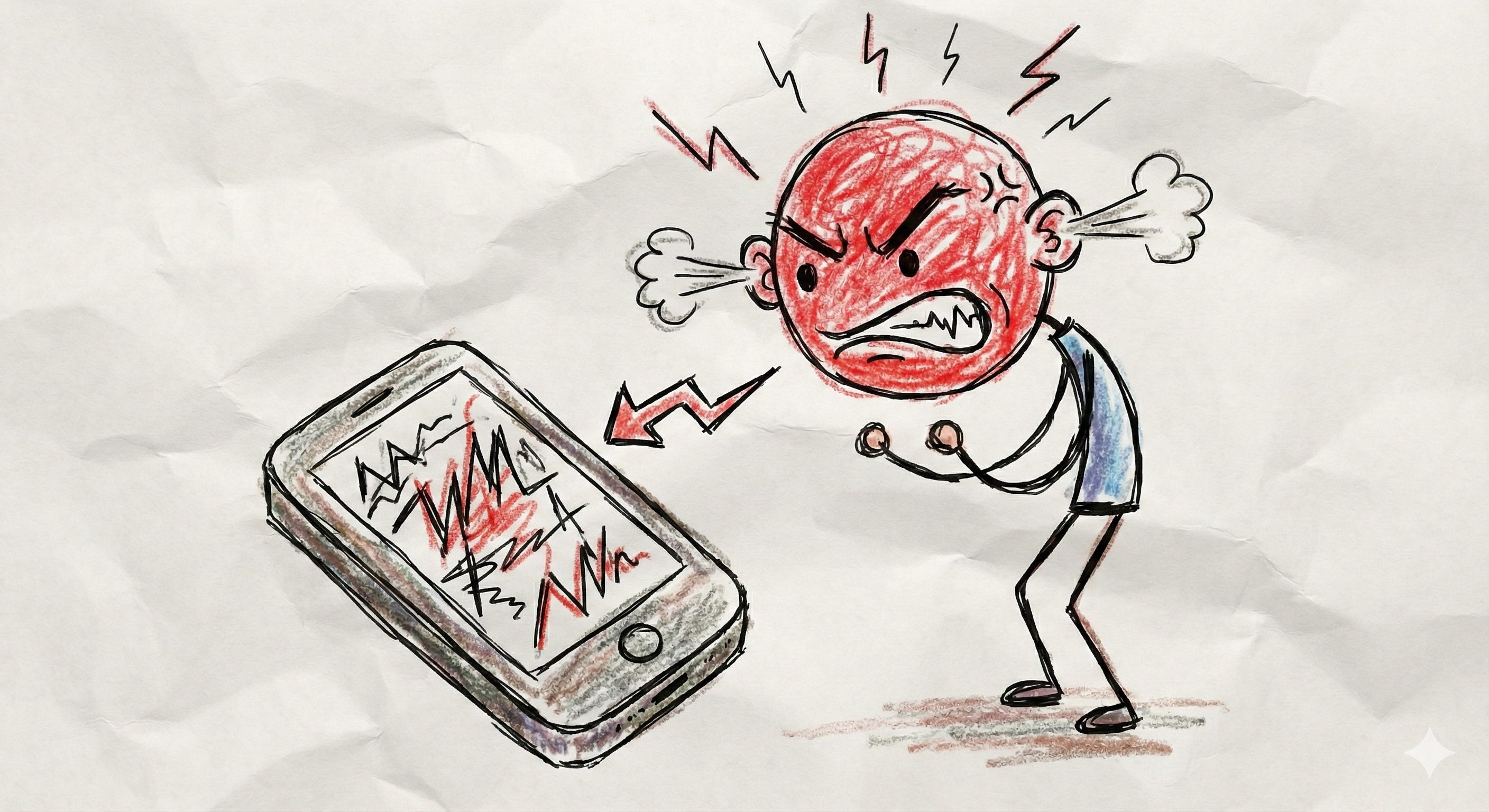
You’re scrolling through your feed. A video pops up of a mother explaining why she never tells her children “no.”
“It damages their sense of autonomy,” she says. Behind her, one kid is drawing on the wall while another eats something off the floor.
You don’t have kids. You’ve never met this woman. But suddenly you’re reading every comment, watching the reaction videos, and your heart rate is up.
Thirty minutes later, you’ve consumed an entire ecosystem of outrage about a stranger’s parenting choices that will never affect your life.
You think: Why do I keep doing this?

This is a collaboration with Laurie Marbas, MD - a family and lifestyle medicine physician who spends her days helping people undo the damage of stress, poor habits, and modern life - one small habit at a time.
You're Wired to Call Out Bad Behaviour - and Platforms Cash In.
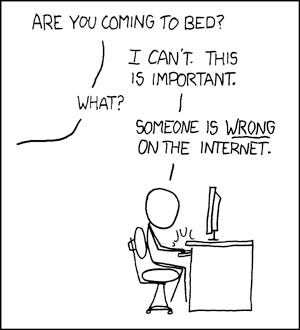
Rage bait is a manufactured norm violation.
Notice what rage bait actually is. It’s almost never something dangerous. It’s someone doing something wrong. A influencer wasting expensive food. A stranger with a terrible opinion.
Your brain has dedicated machinery for detecting this. When you witness someone violating a norm, a region called the anterior insula activates - the same area that processes physical disgust.
This system exists because, for most of human history, norm violators were genuinely dangerous. In small groups, a cheater or free-rider threatened everyone’s survival. Someone who took more than their share, broke trust, or ignored the rules wasn’t just annoying - they could destabilise the entire group. So we evolved to notice rule-breakers immediately and feel a visceral response: that’s wrong.
That instinct hasn't updated for the modern world. So when you watch someone sous vide a chicken in their dishwasher, your brain responds as if they're wasting your tribe's resources.
Calling out bad behaviour feels good - and builds alliances
We didn’t just evolve to detect norm violations. We evolved to respond to them publicly.
In small groups, enforcement was a social act. When you called out a cheater, you weren’t just correcting them - you were signalling to everyone else: I see what’s wrong, and I stand against it. That signal built trust with allies and warned potential violators they’d be noticed.
This is why anger travels further than any other emotion online. Researchers who analysed 70 million social media posts found that anger spreads more easily between users than joy, sadness, or disgust. Joy stays local - you share good news with people who already care about you. But anger is coalition-building. When you share outrage, you’re asking strangers: Are you with me?
And the act is inherently rewarding. Brain imaging shows that when people punish unfair behaviour, the dorsal striatum lights up - the same circuitry triggered by food, sex, and money.
In short, rage bait exploits a three-step loop:
1. Your brain flags a norm violation
2. You feel the urge to respond publicly
3. Your brain rewards you for doing it
Run the loop enough and it rewires your brain
Detect, broadcast, reward. Detect, broadcast, reward.
Your brain is plastic - it reshapes itself around whatever you repeat. Each cycle cuts the groove a little deeper. Do it enough and the behaviour stops requiring a decision. It just happens. That’s what a habit is.
This is how you lose thirty minutes to content that makes you feel worse. You’re not choosing to engage anymore. You’ve trained your brain to do it automatically.
Creators have learned to trigger this loop on purpose
Platforms promote engagement. Creators get paid for reach. Your brain reliably engages with norm violations.
The economics write themselves.
So people manufacture outrage for a living. They waste food, destroy products, say something absurd - not because they mean it, but because your wiring is predictable and profitable.
A couple recently posted a video cutting the soles off their shoes to “feel more grounded with the earth.” Sixty million views. Roughly $30,000 in earnings.
The Hidden Cost: What Outrage Does to Your Body
Laurie Marbas, a family medicine physician, sees what chronic outrage does to the body firsthand.
One of my patients couldn’t get his blood pressure under control. We’d adjusted medications and he’d made reasonable lifestyle changes, but the numbers stayed stubbornly high.
When I asked about his daily habits, he mentioned that his favourite pastime was watching the news. He wanted to keep up with what was happening in the world.
As we talked, it became clear this wasn’t passive viewing. He often became angry while watching. Sometimes he yelled at the TV. Sometimes he threw things. Afterward, the stories stayed with him - he replayed them in his head, brought them into conversations, and had trouble sleeping. His nights were restless and his mornings started tense.
I asked him why he didn’t turn the TV off.
He paused and said he couldn’t. He used the word “addicted” without hesitation.
In the end, the only intervention that worked was removing the TV from his home entirely. That change did more for his blood pressure than any medication adjustment.
What this illustrates is that outrage habits aren’t just cognitive. They’re physiological.
Repeated anger activates the stress response. Heart rate rises. Blood vessels constrict. Stress hormones remain elevated. When this happens day after day without recovery, blood pressure stays high and sleep quality deteriorates. The body never fully resets.
The cost of rage bait isn’t just time spent scrolling. It’s paid in blood pressure readings, sleep quality, and long-term health risk.
You can find more of Laurie's work on habit change at Dr. Laurie Marbas.
How to Break the Loop
Habits don’t respond to willpower. They respond to disruption. Here’s how to target each part of the loop:
1. Make the cue visible.
The cue works because it’s unconscious. Your brain flags negative content as a threat before you’ve decided anything.
The antidote is awareness. A 2020 study found that simply explaining manipulation tactics to people made them significantly more resistant. When you feel the pull, name what’s happening: This is engagement bait. This person is playing a character. The take is designed to provoke exactly this reaction.
That moment of recognition creates a gap between stimulus and response - and that gap is everything.
Psychiatrist Jud Brewer, who studies habit change at Brown University, explains why this works. Anger persists as a habit because the brain learns to associate it with a short-term payoff - a sense of certainty, a release of tension. But that payoff depends on acting automatically.
Mindfulness disrupts the cycle. Instead of suppressing the reaction, you notice what’s happening in your body: tight chest, shallow breathing, muscle tension. Curiosity replaces reactivity. And when you observe these sensations rather than act on them, the reward value of the anger decreases. The habit loses strength.
2. Create a cool-down period.
There’s a reason rage bait hits harder now than it used to.
In the past, if something made you angry - a news segment, an annoying opinion - there was a natural gap before the next stimulus. You’d turn off the TV. Walk away from the conversation. The emotion would peak and then fade.
Infinite scroll eliminates that recovery period.
On TikTok or Reels, you swipe and the next video starts instantly. Your nervous system never gets the signal that the threat has passed. You’re not processing one piece of content - you’re bathing in a continuous stream of stimulation, and the algorithm has learned that outrage keeps you watching.
The result: anger doesn’t spike and cool down. It compounds.
The fix is structural. Set hard time limits on short-form video apps - fifteen or twenty minutes maximum. Use your phone’s built-in screen time controls, or delete the apps entirely and access them through a browser when you genuinely want to.
For some people, like my patient, curiosity alone isn’t enough while the cue remains constant. Removing the cue entirely - whether that’s the TV or the app - allows the nervous system to settle. Once that happens, other changes become possible.
3. Don’t amplify it.
Rage bait has two stages. Stage one is the original provocation. Stage two is the reaction industry - the commentary, the quote-tweets, the “can you BELIEVE this” videos.
Stage two feels like accountability. But it’s distribution. Every reaction video shows the original to more people, trains the algorithm, and extends the lifecycle of content designed to waste your time.
New rule: don’t engage with either stage. Don’t comment, don’t share, don’t hate-watch. Scroll past. The algorithm learns from absence too.
4. Find the reward elsewhere.
The current reward is social validation - likes, agreement, the feeling of being on the right side.
But that validation comes from a community united by shared irritation at strangers. Ask yourself if that’s the tribe you want to belong to.
Curate aggressively. Unfollow accounts that consistently provoke anger - especially ones you agree with. Build a feed that rewards your attention with something other than outrage.
The Bottom Line
Remember the mother who never says no to her kids?
She might be real. She might be performing. It doesn’t matter - because either way, her parenting will never affect your life. The only thing that video cost you was thirty minutes and a worse mood.
That’s the trade you’re making every time you engage: your time and your emotional state, in exchange for the feeling of being right about a stranger.
Your brain evolved to care about threats. That was useful when threats were real and rare. Now you’re connected to a machine that generates infinite fake threats because your reaction is worth money.
The anger is real. The provocation is manufactured. And if you’re not careful, the cost shows up not just in lost time - but in your sleep, your stress levels, and your health.
You can break the loop. But first, you have to see it.
If you found this helpful, make sure to like or restack! These articles take considerable research, and your support keeps me going. (Coffee tips always welcome below ☕)
Thank you Dominic and Laurie for laying this out with such clarity and restraint. What resonated most for me is how you disentangle moral emotion from moral action—showing how outrage can feel like integrity while quietly eroding agency and health.
One thought your piece stirred is that rage bait may be training us to confuse attention with responsibility. When every perceived norm violation demands a response, discernment collapses. Not everything wrong is ours to carry, and not every reaction is a contribution. Relearning selective attention may be as much an ethical skill as a neurological one.
It's so difficult to break the loop when other people are actively trying to get you…and on every single social media platform.