


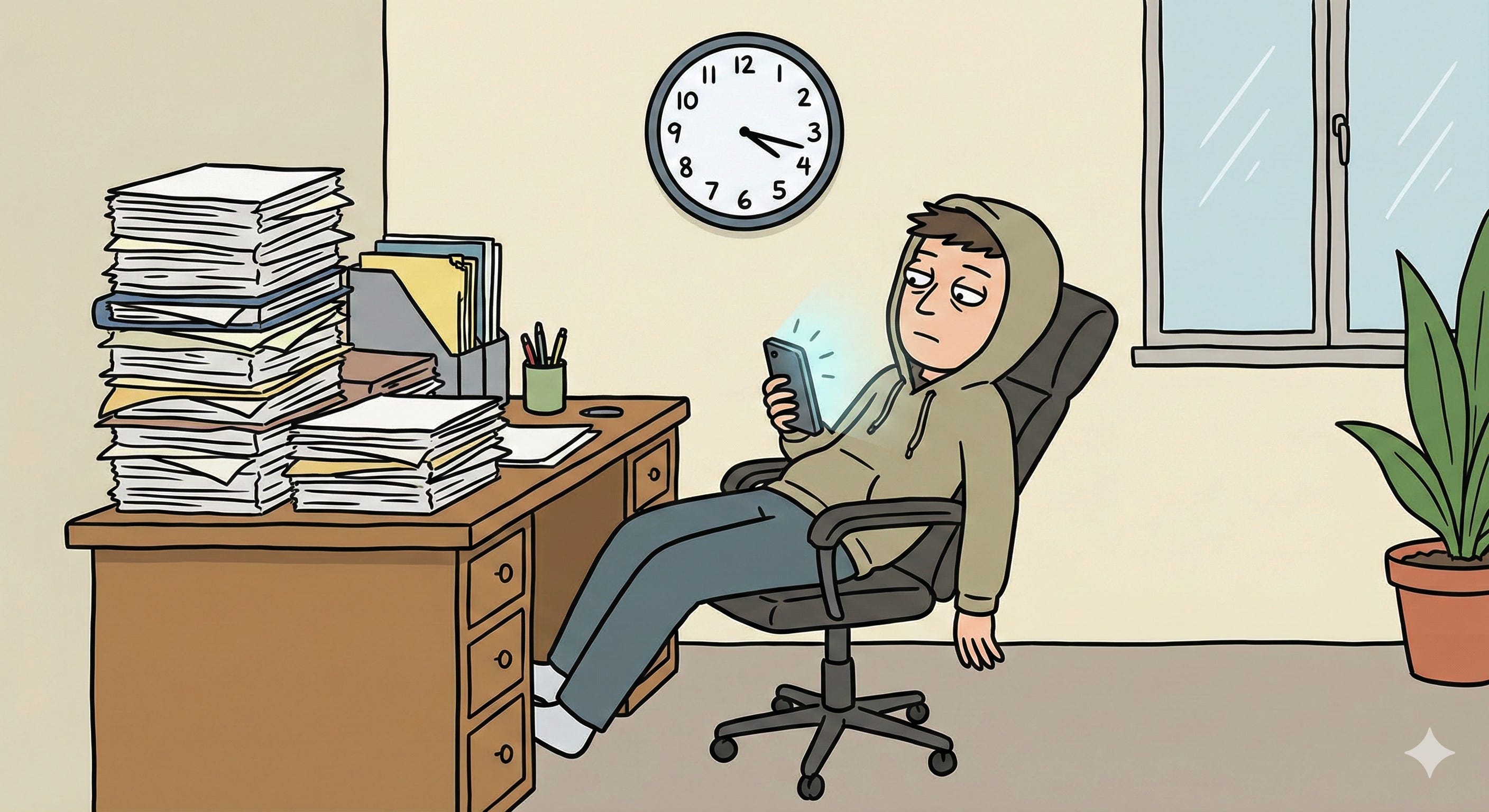
You have a task. You know it matters. You’ve known about it for days. But instead of doing it, you’re reorganising your desk, checking your phone, or reading an article about procrastination.
By Monday night, you’re writing in a panic, fuelled by self-loathing and cold coffee, wondering why you always do this.
You probably call it laziness. It isn’t.
Procrastination Is an Emotional Avoidance Response
Laziness is about the work - you don’t want to make the effort, so you don’t. Procrastination is about the feeling. You want to do the task, but you can’t tolerate the anxiety, self-doubt, boredom, or fear of failure your brain attaches to it, so it redirects you toward something easier.
This is why you can procrastinate on a task that takes ten minutes. The amount of work is irrelevant - what causes the delay is the emotional weight your brain attaches to it.
Procrastinators’ Brains Produce a Bigger Threat Response and Have Less Wiring to Override It
Brain scans of 264 people found two structural differences in those who procrastinated most.
A larger amygdala. The amygdala evaluates threats and generates emotional reactions. A larger one produces a stronger alarm in response to a task - more anxiety, more dread, more urgency to do something else.
Weaker connectivity between the amygdala and the dorsal anterior cingulate cortex (dACC). The dACC is the part of the prefrontal cortex responsible for impulse control - it’s what should override the alarm and push you to act anyway. When this connection is weak, it can't.
Put simply: a procrastinator's brain produces a bigger alarm in response to a task, and has less wiring to shut that alarm down. And this isn't something you're born with - it's something you built.
Every time you avoid a task, your brain treats the avoidance as a successful response and reinforces it. The amygdala grows larger because it's being used more and the connection to the dACC weakens because it's being used less.
This is neuroplasticity - your brain physically reshaping itself based on what you repeatedly do.
The Same Neuroplasticity That Created the Problem Can Reverse It
Every time you start a task despite the discomfort, you strengthen the override pathway and weaken the alarm. The strategies below work by making that easier to do - either by shrinking the alarm so there’s less to override, or by supporting your impulse control so the override succeeds more often.
1. Reduce the Threat Signal
Correcting the Narrative Lowers Amygdala Activation
Neuroimaging studies show that when people reinterpret a stressful situation, amygdala activity drops.
So before you start the thing you're dreading, notice the story your brain is telling. Then replace it with something more accurate.
“This presentation will expose how little I know” → “I’m sharing something I’ve been working on. I know this better than most people in the room.”
“If this report isn’t good, my boss will think I’m incompetent” → “This is a first draft. Its job is to exist, not to be perfect.”
The original story is almost always a worst-case fantasy. The key is that the replacement has to be accurate, not overly-optimistic - "This first draft is going to blow everyone away and get me promoted" is just as fictional as the dread.