


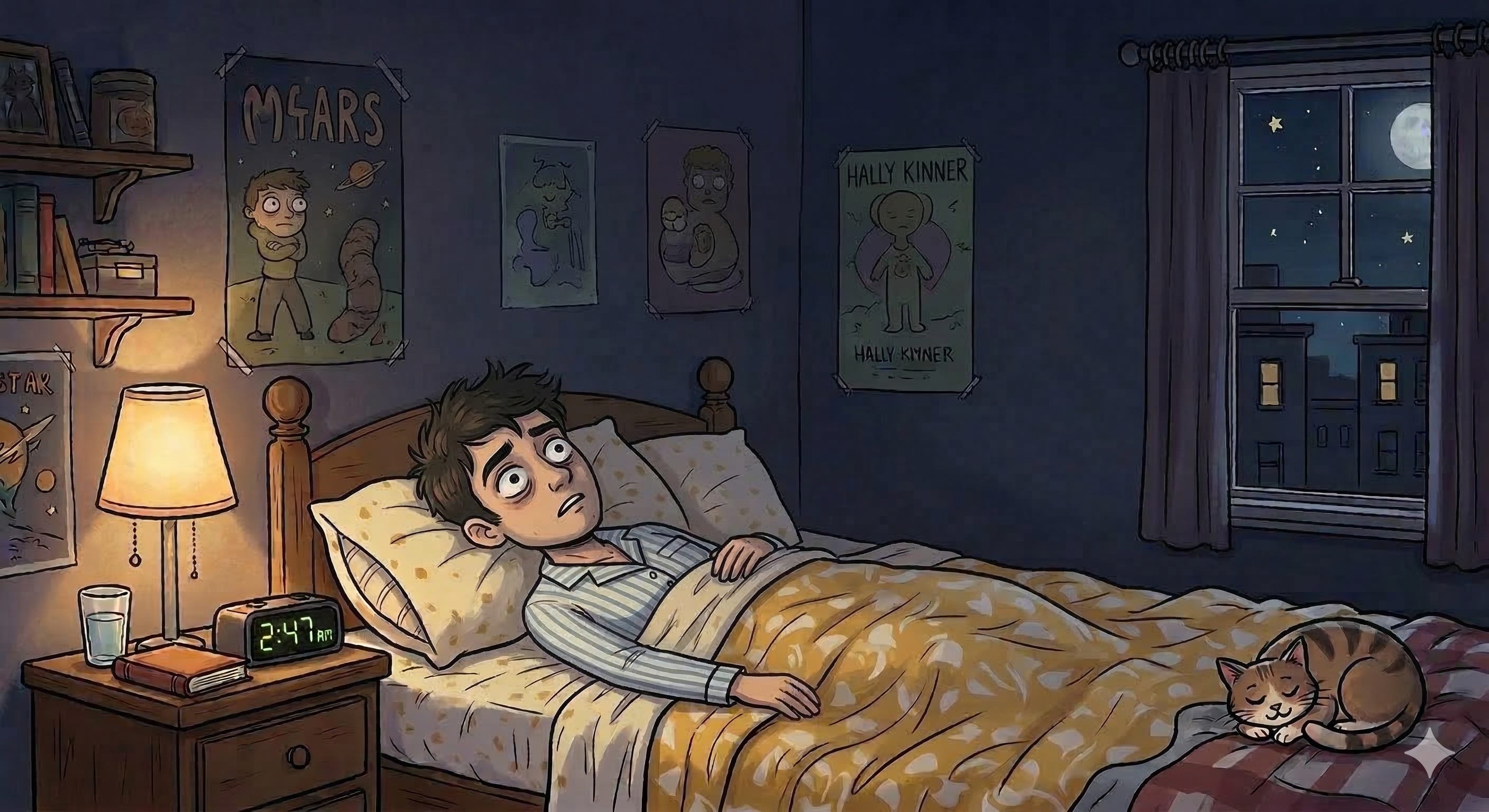
It’s 11:30 PM. You’re exhausted. You turn off the light, close your eyes, and your brain decides now is the time to replay every unresolved thought it can find.
The awkward thing you said at a party in 2016. A sudden concern about your pension. Tomorrow’s schedule, rehearsed in full. The email you forgot to send.
These racing thoughts at midnight may feel random - like your brain is broken and misfiring. But there’s a specific sequence that produces them, and it starts the moment you close your eyes.
Your Brain Starts Talking to Itself When the World Goes Quiet
Close your eyes and the stream of sensory data that kept you anchored to the present all day just… stops. No traffic, no conversation, no screen.
That's when the default mode network takes over - the part of your brain responsible for daydreaming, reflecting, and planning. It's been running in the background for hours, drowned out by work and notifications. But now there's nothing competing with it. So out come the regrets, the worries, the mental to-do lists.
Every brain does this. And for most people, these thoughts don't trigger an emotional response. They drift through, interest fades, and sleep arrives.
The question is why, for some people, they don't.
The Amygdala turns Bedtime Thoughts into Urgent Problems
A 2023 fMRI study found the answer in how two brain regions are wired together.
Researchers scanned 52 people with chronic difficulty falling asleep and 30 healthy sleepers, then tracked each person’s time-to-sleep over seven nights.
The insomnia group showed one clear structural difference: unusually strong connectivity between two brain regions:
The first is the amygdala - your brain’s threat detection system. It decides what counts as dangerous and what can be safely ignored.
The second is the posterior cingulate cortex - a central hub of the default mode network - the network that runs your inner monologue.
In the insomnia group, these two regions were wired together more tightly than normal. And the stronger the connection, the longer it took to fall asleep.
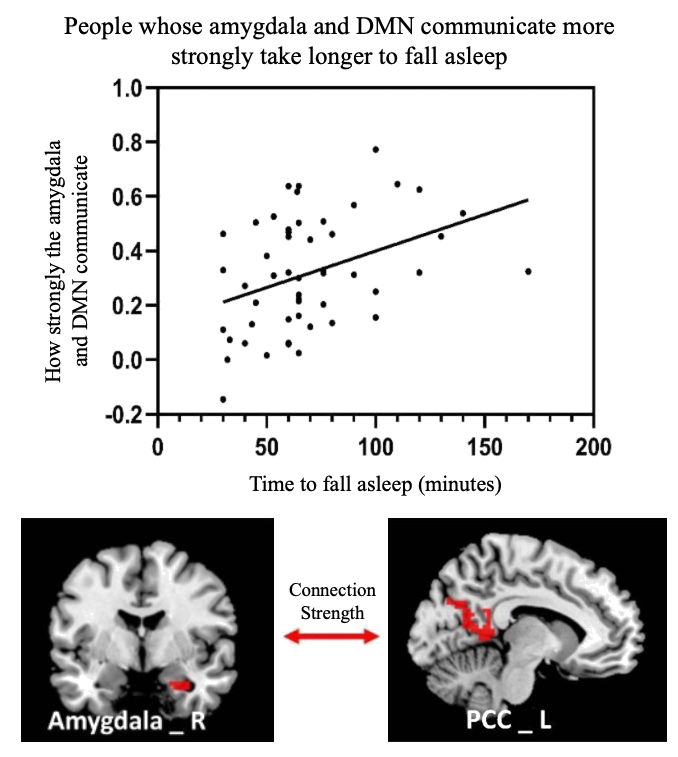
So what does that tighter wiring mean in practice? The default mode network is still doing what it always does - surfacing thoughts like the memory from 2016, tomorrow's schedule, the unsent email.
The difference is that in the insomnia group, the amygdala was more tightly coupled to those surfaced thoughts, adding emotional weight. So the thought doesn’t just appear - it appears and feels like it matters.
How to Fall Asleep When Your Brain Won’t Stop Thinking
So the problem isn't the thoughts - it's that your brain treats bedtime thoughts as threats. The fix is to make those thoughts feel less important, so they can appear and pass without waking you up further.
The first four strategies below work in the moment - when you're lying in the dark and your brain won't shut up. The last two work earlier in the evening, before the thoughts start.
1. Try to Stay Awake Instead of Trying to Sleep
When you try to fall asleep, your brain activates a monitoring process that keeps checking “Am I asleep yet?” and this only wakes you up more. The fix is counterintuitive: stop trying to sleep and try to stay awake instead
In one study, adults who did exactly this fell asleep almost 30 minutes faster.
Here's how to try it:
Get in bed like normal but drop the goal of falling asleep
Just lie there calmly trying to stay awake - no devices, no activities
The boredom + lack of sleep pressure will often do the work for you
2. Naming a Thought Takes Away Its Emotional Charge
A 2025 trial found that reducing thought suppression was the single strongest predictor of sleep improvement in people with insomnia.
When a thought appears, name what’s happening in one short, flat sentence.
Name the category, not the content. “That’s worry about work.” “That’s replaying the conversation with Mum.” You’re tagging it, not engaging with it.
When the same thought comes back, label it the same way. “There’s the work worry again.” It will come back less forcefully each time.
When you get pulled into a thought without noticing - and you will - label it the moment you realise.
This works because naming a thought shifts your brain from experiencing the emotion to observing it.
3. Fill Your Mind With Random Images
Your brain can only attend to so much at once. A stream of unconnected images fills that capacity with junk - leaving no room for the kind of thinking that triggers the amygdala.
In a study of 154 college students, those who used the below technique (called cognitive shuffling) found it easier to fall asleep and reported better overall sleep quality.
Pick a random word - something concrete, like “GARDEN.”
For each letter, slowly visualise an unrelated image. G: a guitar. A: an astronaut. R: a red door. D: a dolphin. E: an escalator. N: a newspaper.
Spend a few seconds on each image before moving to the next letter.
When you run out of letters, pick a new word and start again.
If you drift back into real thoughts, just pick a new word. Don’t get angry at yourself.
4. Your Predictions About How Bad Tomorrow Will Be Are Almost Always Wrong
When you can't sleep, your brain starts generating catastrophic predictions - tomorrow is ruined, you won't be able to function, you need to fall asleep right now.
But these predictions are almost always wrong, and the dread they create does more damage than the lost sleep itself, because it produces the very tension that keeps you up.
When you notice these thoughts, try correcting the specific error:
“I’ve only got four hours left, tomorrow is ruined.” → I’ve had bad nights before and still functioned the next day.
“I haven’t slept at all.” → I’m probably getting more sleep than I think.
Studies consistently show people with insomnia overestimate how long they’ve been awake.
“I need to fall asleep right now.” → Lying quietly with my eyes closed is still rest, even if I’m not sleeping.
Across 16 trials of insomnia patients, 70–80% who replaced these catastrophic thoughts with accurate ones saw their time to fall asleep drop below 30 minutes.
5. Write Down Tomorrow's Unfinished Tasks Before Bed
Your brain doesn't just ruminate on tasks because they're stressful. It often ruminates on them because they're unfinished. Writing them down signals to your brain that the task is handled.
One study found that people who spent five minutes writing a to-do list before bed fell asleep nine minutes faster - and the more specific the list, the faster they fell asleep.
Set aside five minutes before your evening starts.
Write down every unfinished task. Anything unresolved - emails, decisions, half-done projects.
Next to each one, write one concrete next step. Not “deal with the tax stuff” but “email accountant at 9 AM asking for the SA302 form.”
Put the list somewhere you’ll see it tomorrow morning.
6. After Twenty Minutes of Lying Awake - Get Out of Bed
Every hour you spend lying awake strengthens the association between your bed and alertness. Over time, the bed itself becomes a trigger for the racing thoughts you’re trying to escape.
In a trial of chronic insomnia patients, 80% reduced how long it took them to fall asleep simply by getting out of bed when they couldn’t sleep.
If you’ve been awake for roughly twenty minutes, get up.
Go somewhere quiet and keep the lights low. Do something understimulating - a boring book, a simple puzzle, nothing with a screen.
Return to bed only when you feel sleepy. Not tired. Sleepy. The droopy-eyed, struggling-to-stay-awake feeling.
Repeat if needed. If you return and don’t fall asleep within another twenty minutes, get up again.
The Bottom Line
Your brain keeps you awake in a specific way: a thought appears, your amygdala treats it like a threat, and the alertness that follows produces more thoughts.
And the reason “just relax” doesn’t work is that the problem was never the thoughts themselves. It’s that your brain flags them as threats the moment they appear.
Everything above works the same way: it lowers the stakes of whatever your brain produces, so a thought can come and go without waking you up further.
This article covers common sleep difficulties, not clinical sleep disorders. If your insomnia is persistent, severe, or accompanied by other symptoms, talk to your doctor.
Found this utterly fascinating. I think I'm one of the unfortunates re the amygdala!
More and more people I know use podcasts to soothe to sleep. I was researching for a piece I was writing about it, and was stunned to discover half of American podcast listeners do just that.
I'm convinced we need to learn to cope with the silence. From my experience takes a little patience and training.
Your strategies here seem very valuable and actionable, will definitely give them a try.
I have personal experience with sleep-performance insomnia and can viscerally relate to everything you wrote in this great article.
The two biggest movers of the needle for me were: (1) finding a way to accept the state of being awake, and (2) awareness the next day of the "impacts" of the bad night of sleep, and how they actually paled in comparison to the catastrophising thoughts the night before.
Acceptance (point 1) required practicing meta-awareness. When hit with a wave of panic, I would compassionately acknowledge the sensation (and thoughts) and then redirect my attention to the present moment. Again and again. This in itself would bring online the PFC and tamp down that over-wrought amygdala.
Wishing luck to anyone else going through a similar situation. Insomnia can feel so debilitatingly isolating.